
There’s something magical about Costa Rica in rainy season. Despite what you may hear, vsitors CAN still have an incredible time in Costa Rica during rainy season.
However, there are some things to know so you come fully prepared.
Below is our guide to visiting Costa Rica in the rainy season, the Costa Rica rainy season months and our tips for a safe and fun trip.
Important: If you will be disappointed for the rain or are very concerned about it, then do not visit Costa Rica in the rainy season, at least in the peak rainy season months. Change your trip to visit during the dry season.
This post has affiliate links which we may earn a small commission from if you choose to purchase, at no extra cost to you. Listed prices are quoted in USD and are estimates. More info: Disclosure
When is Costa Rica’s Rainy Season?
Rainy season in Costa Rica is generally beginning of May to end of November. This is for the majority of the country.
Although there aren’t the four seasons in Costa Rica, rainy season is considered Costa Rica’s “winter.” It is also known as “green season.”
The transition month from dry to rainy is April. The rainiest month in Costa Rica is October.
It is important to note that the Caribbean coast (Limon province) follows its own weather pattern and doesn’t strictly adhere to the rainy season months. October is actually their summer month. We will talk about the Caribbean coast later on.
December, though technically is the last month of rainy season, is more like the transition month from rainy to dry season.
As Costa Rica has over 20 micro-climates, average day and night time temperatures and the abundance of rain varies throughout the country.
However, the average day and night time temperatures do not vary greatly between rainy and dry season.
Read more about Costa Rica weather here.
Central Valley (San Jose, Heredia, Cartago, Alajuela)
In the city, average day time temperatures are around high 70s° F (26° C), Average night time temperatures are around 60-65° F (15°-18° C). These are areas such as San Jose, Alajuela, Cartago and Heredia.
If you go up to the mountains outside the city, it gets cooler, windier and tends to rain a bit more at night.
This area can start to rain around end of March/beginning of April (sporadic rains in the evenings/nights).
Guanacaste Coast and Nicoya Peninsula
On the Northern Pacific coast (Guanacaste and Nicoya Peninsula), it is much drier. It is still very hot, around mid 80s° F (30° C) and very humid.
It doesn’t really start raining hard constantly until about August/September.
Mornings are mostly cloudy and dry and it may start raining on and off throughout the late afternoon and nights.
May is more of the transition month in this area and can start getting rain in the evenings and nights.
Central and South Pacific Coast (Jaco, Manuel Antonio, Costa Ballena, Osa Peninsula)
For the Central and South Pacific coast (Jaco/Manuel Antonio/ Dominical, Uvita, Ojochal/Osa Peninsula), this area is very humid and tends to rain more, being the tropical rainforest.
Average day time temperatures are around mid 80s° F (29° C) with high humidity.
This part of the Pacific coast can start seeing rains around beginning of April, l but it can also rain during the dry season months like January and February.
Mountaineous Areas (Monteverde, San Isidro de Perez Zeledon, San Gerardo de Dota, etc.)
In the high elevation, mountainous areas such as Monteverde, San Isidro de Perez Zeledon, Bajos del Toro, Poasito, San Vito and San Gerardo de Dota, it is much cooler, windier and fresher.
Daytime temperatures are around low to mid 70s° F (21°-23° C) and cools off at night to low 60s F (15-16 C). It can get even colder if it’s windy.
San Gerardo de Dota can get even colder, down to 50 F (10 C) at night as it sits nearly 2000 meters (6500 ft) in elevation.
These areas are not very humid due to the high elevation.
Caribbean coast (Limon province)
On the Caribbean coast, Tortuguero and Puerto Viejo follows a different weather pattern.
The rainiest month is normally July but this area can rain any time of the year. October is their summer month.
Average day time temperatures are around low to mid 80s° F (29° C).
Temperatures During Costa Rica’s Rainy Season
Average day time temperatures in Costa Rica don’t vary too much throughout the year, even between the dry and rainy seasons. In rainy season, it does cool off a little tiny bit but you get very high humidity in return.
For more information, you can our Costa Rica’s weather post.
Want more Costa Rica travel tips? Join our mailing list and get our free Costa Rica eBook!
Why You Should Visit During Costa Rica’s Rainy Season!
Wildlife Watching Galore
Although you can see wildlife in Costa Rica any time of the year, there are certain times where you can witness natural phenomenons that only happen during rainy season.
Wildlife watching during Costa Rica rainy season is excellent when it comes to marine wildlife.
One of the best scuba diving spots in Costa Rica, the Bat Islands (Islas Murcielago), is only accessible during the rainy season (May – November).
The islands have an extremely healthy and large population of bull sharks and manta rays!
Turtles
If seeing turtles is high on your bucket list, then you must visit Costa Rica in rainy season.
Ostional Wildlife Refuge experiences a mass gathering of nesting turtles (called arribadas) during this time of year.

These arribadas are best in September, October and November. Thousands of turtles come onto shore to lay their eggs during arribadas!
In Tortuguero, another excellent destination for turtles, the nesting season is May – October.
Whales and Dolphins
If you want to see whales, good news! Costa Rica has one of the world’s longest humpback whale season and there are great chances to see them December to mid-March and July through October.
In Uvita, they hold the whale and dolphin festival in August since it’s such a good time to see whales and the best place in Costa Rica to see humpback whales.
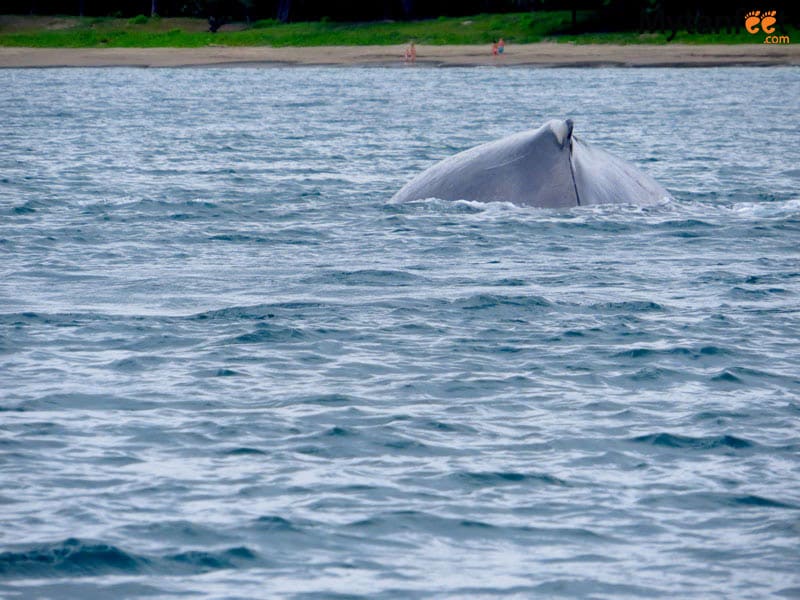
There are several other fantastic places in Costa Rica for whale watching such as Drake Bay, Manuel Antonio, Gulf of Nicoya, Golfo Dulce, Santa Rosa National Park, Gulf of Papagayo, and Catalinas Islands.
We have seen humpback and pilot whales in the Gulf of Papagayo and near the Catalinas Islands by Flamingo beach.
It’s So Green!
There’s a reason why they say green is nature’s color and makes people feel refreshed and calm.
In the dry tropical forest, such as the Guanacaste coast and Nicoya Peninsula, the mountains turn spare, yellow and dry during the dry season months.
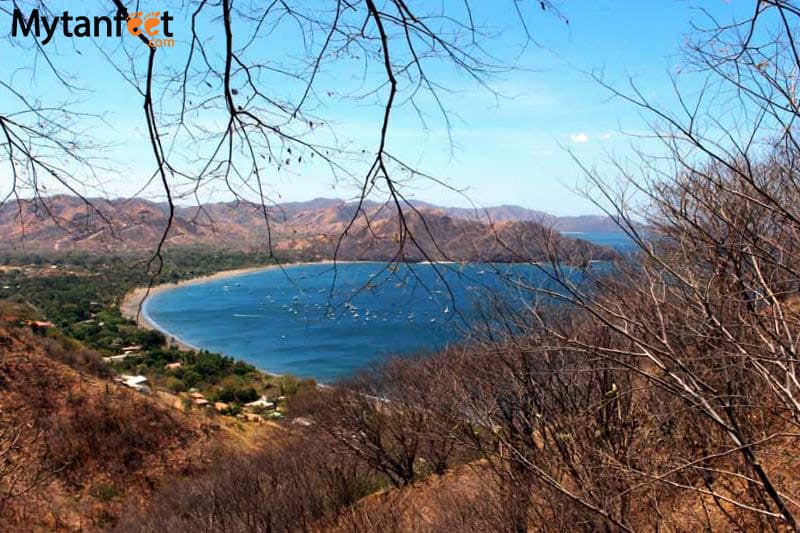
But as soon it rains a few times, they transom into lush green jungle covered mountains.
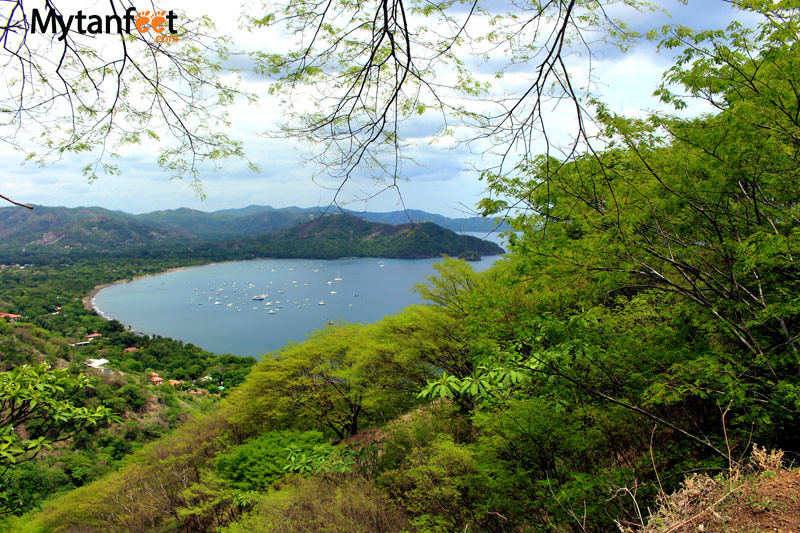
Look how much more beautiful it is when it’s all green!
Save Money During Costa Rica’s Rainy Season
If you’re planning on traveling in Costa Rica on a budget, rainy season is definitely the best time to visit. Hotels in Costa Rica normally have three different seasonal rates: low, high and peak.
Low is rainy/green season, high is dry season and peak is during Christmas/New Years and Semana Santa (Easter week).
Low season rates can be a good amount less than high season. For example, a hotel that is normally $100 USD a night in high season may be $80 USD a night in low season. Same goes for car rentals.
Additionally, some tour companies or restaurants may run promos in the lowest months of September and October.
When we visited Manuel Antonio in October, a ton of restaurants had 30-50% off their entire menu (cash only).
Be aware that July, particularly the first and second week of the month is considered high season due to North America summer vacation and Costa Rican mid winter vacation.
When we traveled to La Fortuna with my parents, it was hard to find hotels since many of them were full and prices were normal like high season. August is also high travel season on the Caribbean coast.
The cheapest times to travel in Costa Rica are the shoulder months of May, June, September and October.
Rivers and Waterfalls are Fuller During Costa Rica Rainy Season
Water levels are much lower during dry season and water sports such as rafting and tubing aren’t quite as exciting.
We’ve gone white water rafting and white water tubing in both dry and rainy season and we have to say hands down, rainy season is way more fun!
The rapids are much more thrilling to raft through with gushing waters and dark green jungle surrounding you.
Book our favorite white water rafting trip in Costa Rica, the Pacuare River here!

Same with tubing. With low water levels you don’t bounce around nearly as much as rainy season when the rivers are full. Still fun in dry season but definitely more in rainy!

Likewise, waterfalls are normally drier and smaller in dry season, especially in Guanacaste and Nicoya Peninsula.
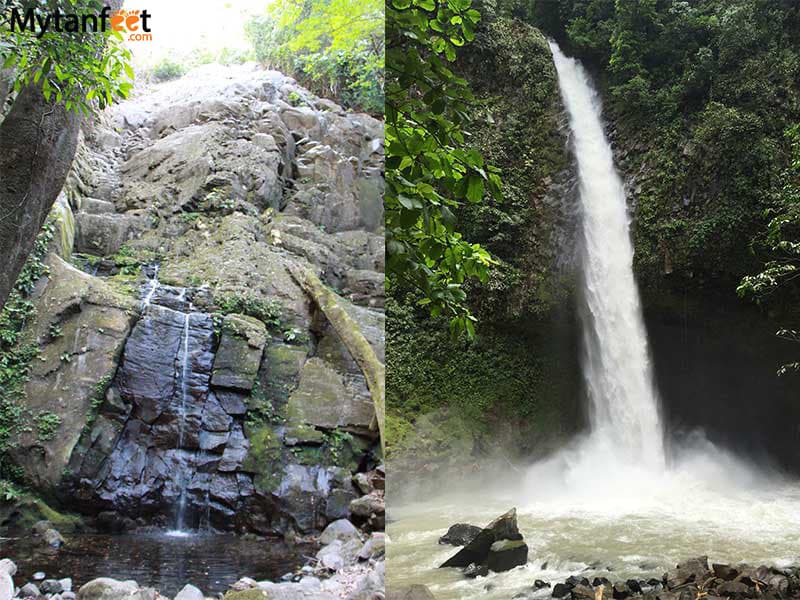
During rainy season, the waterfalls fill up. There’s nothing more breathtaking than seeing a huge waterfall dropping from a tall cliff. It’s not quite as impressive when it’s a tiny stream.
But Keep in Mind…
One downfall to rainy season is that the color of water for rivers and waterfalls may change.
La Fortuna waterfall is actually a pretty bright green/blue but it can be a grey-brown during peak rainy season. The color change is due to the sediment and dirt run off from the rain.
Keep this in mind if you plan to visit blue waterfalls and rivers like Las Gemelas, Rio Celeste or La Leona. If there is a storm or it has been raining for several days consecutively, those rivers won’t be that sky blue color anymore. Instead, it can be a murky brown or grey.
Another downside is that during the peak rainy season months, the rivers may get too full. In those situations, it will not be safe to raft, tube, hike or swim and those tours will not run.
This can happen more during August, September, October and November.
Enjoy Beaches All to Yourself
Rainy season means less tourists and we have had beautiful beaches all to ourselves many times during this time of year.
Even places that are normally very busy like Manuel Antonio empty out once September and October roll around.
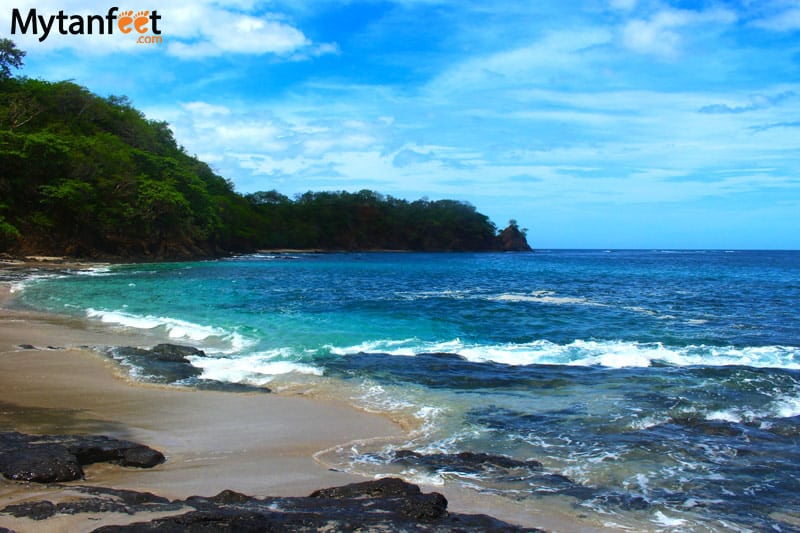
Rent a car, explore and you can find beautiful beaches all to yourself! It’s one of the best parts about the Costa Rica rainy season.
The Most Helpful Tips for Visiting Costa Rica in Rainy Season
Tip 1: Consider destinations that are not far from the international airports in Costa Rica. That way you don’t need to worry about driving long distances in the rain.
Tip 2: If you are really concerned about rain, consider rescheduling your trip to the dry season (December to April).
If you can’t reschedule, then consider visiting the Caribbean coast if you will be coming in October and the Guanacaste/Nicoya Peninsula for May through August as those are the drier areas in the country.
I planned this specific 2 week Costa Rica itinerary for family and friends who visited me in August and it worked out great in the rainy season.
Check our Costa Rica itineraries for more information!
Tours
- Schedule your activities in the morning. Mornings tend to be dry and cloudy. It tends to start raining in the afternoons.
- Check Facebook or Instagram accounts of the tour you’re doing, hotels you booked and places you’re visiting. They may post updates on conditions.
- You don’t necessarily need to pre-book all your activities. You can wait and see how the weather is to book.
Packing
- Bring plenty of mosquito repellent. Mosquitoes are absolutely awful in rainy season. Read our post about our favorite bug repellents for Costa Rica. This is one of our favorite DEET free mosquito repellents.
- Bring waterproof gear. We never leave without our waterproof backpacks, an umbrella and rain jacket. Get our packing for Costa Rica during rainy season guide.
- Don’t forget sunscreen. Even if it’s cloudy, the sun is still strong.
- Bring clothes that are lightweight, dry fast and wick moisture away. You’ll get wet and sweat a LOT. We love bamboo fiber, microfiber and lightweight merino wool (less than 150 gsm).
- The power may go out during rain or thunderstorms. Bring a battery pack to always keep your phone charged.
- Bring a headlamp or small flash light.
Get our Costa Rica packing list with rainy season tips here!
Driving
- We don’t recommend to drive long routes (2+ hours) at night. Night tends to rain the hardest.
- If your flight lands after 3-4 PM and your next destination is 3 hours way, stay a night near the airport and then leave early the next morning.
- It gets dark by 6 PM everyday in Costa Rica.
- If you plan on renting a car in Costa Rica, rent a GPS or use Waze/Google Maps. Download Google Maps to work offline as back up. Get our Costa Rica car rental discount here!
- We also recommend to get a Costa Rican prepaid SIM card so you can make phone calls in case of emergency. Only have eSIM? Get 10% off your Airalo eSIM package with our promo code “mytanfeet”
- When using GPS, do not take the shortest route or that detour. Most of the time, it is through an unpaved road. Always take the paved route and check road conditions.
- Rent a 4×4/4wd if you plan to explore, are staying up in the mountains or staying in places outside the main tourist zones.
Find out what other things to know about Costa Rica before you go here!
Costa Rica Rainy Season By Month
Although tropical weather is more unpredictable, here is a general breakdown.
Costa Rica is also affected by the El Niño y La Niña events which may influence how much it rains and when the rainy season starts/ends for the year.
In Costa Rica, El Niño tends to bring drier weather with a later rainy season.
April
Although Costa Rica in April is *technically* dry season, the weather generally starts to transition around mid to end of April in some parts of the country.
Rain may occur in places like the Central Valley, La Fortuna or South Pacific. The North Pacific coast places may start getting cloudier and get a random rain here or there the last week of April.
April is very hot and gets very humid.
May
What the weather is like in Costa Rica in May: May is the first month of the rainy season, though it will gradually start raining more.
It may rain off and on sporadically and some days may be rainier than others in the rainforest and mountain areas.
Days are still hot, though cloudy and humid. It may rain very hard for 10 minutes and then be super sunny for the rest of the afternoon.
Mornings are generally still very clear and beautiful.
The Caribbean coast can be very rainy in May as it doesn’t follow a strict dry-rainy tropical climate.
June
What it’s like to travel Costa Rica in June: June is proper rainy season. Depending on the type of year, June can be quite rainy with some tropical storms or hard rains. Although it doesn’t rain all day every day, come prepared.
In drier years, it doesn’t rain as much but in wetter years, it can rain consistently in the afternoons, evenings and overnight.
June on the Caribbean coast is similar to May.
July
What it’s like to travel to Costa Rica in July: July has what the locals call “little summer.”
This little summer is around mid-July and the weather tends to dry up, as if it’s dry season. It even has clear blue skies and little humidity.
Although it can still rain in July in the rainforest areas, it is generally drier and a great month to visit Costa Rica. July can be a lot rainier on the Caribbean side.
August
What it’s like to travel to Costa Rica in August: It starts going back to the typical rainy day with sunny mornings and cloudy afternoons.
Rain can start picking up more in the afternoons and nights and more often towards mid to end of August. Starts to rain more in the rainforest and cloud forests.
September
What the weather like in Costa Rica September: September is the start of the rainiest months in Costa Rica. Expect more cloudy days and rainy afternoons and nights.
Starts to dry up in the Caribbean. September and October tend to be the coldest months in Costa Rica.
October
What it’s like to travel Costa Rica in October: This is the driest month for the Caribbean side but the worst for the rest of the country.
Expect sudden rain storms during the day and rain late into the night. On the Pacific coast you will still get dry but cloudy mornings but by afternoon, it’ll start raining.
There are also many possibilities of big storms in October and when it storms in Costa Rica, it storms good. In 2018, the Guanacaste coast was hit by a tropical storm in October. Roads flooded, people got stuck.
This is a great reason why you should purchase travel insurance for your trip if you plan to visit during rainy season. Travel delays and cancellations can be common.
November
What it’s like to travel Costa Rica in November: Expect a good amount of rain throughout the country still. Some areas, start transitioning to dry season at the end of the month, but can still rain in the afternoons and nights, particularly the Pacific coast.
At the end of November 2017, the Costa Rica Northern Coast got hit by Hurricane Otto, the first hurricane since 1996. In 2024, the Pacific coast received more rain in November than it did in previous years (record setting).
December
What it’s like to travel Costa Rica in December: Beginning of December is very nice as it is drying up. It can still rain here and there beginning of December but by the end of December, it’s not common to have the super hard rains.
It usually gets very windy in December throughout the Central Valley and North Pacific coast. If there is a cold front up north in the Atlantic, the Central Valley will also be affected.
Best Things to Do in Costa Rica Rainy Season
Fishing in Costa Rica is generally very good in rainy season, especially for mahi mahi and tuna.
White water rafting and tubing: Rivers are fuller like I mentioned before so it’s a lot more fun! Take note if you’re visiting September – November though the weather may get too crazy.
Tour companies will cancel rafting tours if the rivers are too full or weather becomes dangerous so if you visit those months, be aware that it may happen.
Coffee tours: The coffee harvest season starts around September to December/January so you can see the entire picking, separating and processing procedure.
Museums: In San Jose, you can visit the Central Market, the museums or National Theater.
Enjoy the rain! We absolutely love sitting on our covered balcony with a hot cup of tea or coffee, watching the rain fall while listening to the thunder.
We also love seeing the crazy lightning storms. Taking a nap in the rain is also pretty nice!
Be Prepared for Costa Rica Rainy Season
Whether you visit Costa Rica in the rainy season, the most important thing is to be prepared and flexible.
Bring appropriate gear, schedule your activities in the morning, don’t plan to drive long routes in the late afternoons and after dark and consider planning an itinerary that doesn’t go to very rural/remote places if you can’t rent a 4wd.
If you will be disappointed that it’s raining or are concerned about rain, then do not visit Costa Rica in the rainy season. Change your trip to visit during the dry season.
Costa Rica Vacation Checklist
- First time to Costa Rica? Read our First Time in Costa Rica guide.
- Not sure how to move around Costa Rica? Read our How to Get Around Costa Rica guide to find the best transportation method for you.
- Click the link to get our detailed Costa Rica Packing List so you know what essential items to bring.
- Check our Costa Rica destinations mapand Costa Rica restaurant map
- Do not forget to purchase Travel Insurance for your trip to Costa Rica.
- Stay connected by purchasing a prepaid SIM Card in Costa Rica. Get 10% off your Airalo eSIM package with our promo code “mytanfeet”
- Save money with Mytanfeet Deals for tours and hotels. Save more money with our Costa Rica Car Rental Discount.
Stacy says
I am visiting Playa Azul Beach (a cove of Playa Ocotal) in Guanacaste from mid to late October. I told my travel agent that I was looking for a hot beach bum vacation, but all sources of info seem to say that my agent steered me wrong. Did she? If so, are there other things to do that make this trip still worthwhile?
Sammi says
Hi Stacy, October is the rainiest month for the Guanacaste coast. Mornings generally are still dry and clear but it normally starts getting cloudy and rainy by noon and throughout the afternoon and evenings. I think if you’re looking for like the ultimate beach vacay, I’d change to dry season where you won’t get a drop of rain (like January, February, March) on the Guanacaste coast. And if we get a tropical storm or wave in October, the rains can be very hard and constant throughout evenings and nights. This year is an El Niño, a very strong one so it’s been quite dry compared to past rainy seasons, but October can be a really heavy one for rain since we haven’t got as much rain as we normally would so far.
Pam says
Hello, we are planning on visiting the Parrita, Manuel Jose, Jaco areas from Aug-25-Sept 6th. Do you think the weather on the Pacific side will completely affect our trip? Also, if we are able to move our trip to Aug 9-18th, is the rain likely to be less severe?
Thanks,
Pam
Sammi says
Hi Pam, August and September are our rainy season months, September heads deeper into the peak rainy season months. You can read about Costa Rica in August and Costa Rica in September in our posts. Whichever time you visit, you must prepare for rain and plan your itinerary accordingly, but probably a tiny bit more for September days. It’s still the beginning of Sept so unless we get a tropical storm it’ll be about the same as August.
Emily says
Hi!
Planning to come the last week of July. Does it rain at the beach every day or just in the forests? We’re thinking about San Jose for a night then renting a car to go to Uvita. Would Uvita be a central place to be able to hike, raft, and go to the beach? Thanks!
Sammi says
Hello Emily, you can read about July in Costa Rica here. July tends to have a “little summer” where it doesn’t rain as much, and is like summer, but this is variable and dependent, not always a guarantee. Uvita is a beautiful beach town, since you’ll have a car you can explore around to different places, the closest white water rafting will be up more north in Savegre/Naranjo, which is kind of far from Uvita but it is possible since it’s a popular day trip from Manuel Antonio and you can drive to the operation center on your own.
You can get our Costa Rica Car Rental Discount here
Sunny says
Hello,
We are going to Costa Rica ending of November and renting car. Have 2 young children.. how is the road from Liberia airport to Monteverde, close to the cloud forest to stay.
Will it be dangerous driving there at night?
Gps says the trip will take under 3 hours.
Sammi says
Hello Sunny, we’ve sent you an email
Claire says
I am heading to Costa Rica July 2023 to Hotel Bosque del Mar. Any recommendations on things to see in the area? I’m trying to decide if I’ll need to rent a car or not.
Sammi says
Hi Claire, we have sent you an email with more information
Kathy K says
I had planned to visit Manuel Antonio in October but after reading that it is the WORST month for rain, I am considering changing our trip to the Carribean side. Would you recommend that?
Sammi says
Yes October is our rainiest month except its summer on the Caribbean coast