
What is the best side of Costa Rica to stay on? What side of Costa Rica has better beaches? How can I visit both? What are the differences between the Caribbean and Pacific coast of Costa Rica?
If you’re planning your trip to Costa Rica, you may be wondering these exact questions.
Both sides of Costa Rica are excellent places to visit for all tourists.
Although we recommend visiting both coasts of Costa Rica if possible, it is not as easy due to long travel times.
Here are the differences between the Caribbean and Pacific coast of Costa Rica to help you decide which side is best for you.
This post has affiliate links which we may earn a small commission from if you choose to purchase, at no extra cost to you. Listed prices are quoted in USD and are estimates. More info: Disclosure
Caribbean and Pacific Coast of Costa Rica: Main Tourist Areas
It is absolutely worth visiting the Caribbean coast of Costa Rica since it has pristine tropical rainforest, fantastic wildlife watching and gorgeous beaches.
However, it has a different climate than the rest of the country and a shorter coastline so there are some very important things to know about the Caribbean coast before you visit.
Caribbean
The entire Caribbean coast is in the province of Limon and is divided into two main areas: Caribbean North aka Tortuguero and Caribbean South aka Puerto Viejo de Talamanca.
Tortuguero, nicknamed “Little Amazon” is a tiny boat/plane access only rural town. It’s famous for Tortuguero National Park, rainforest covered sandbar canals and green turtle nestings.
It’s fairly remote but many people visit to experience an untouched pristine jungle. You can read this post on how to get to Tortuguero. Most people spend 1-3 nights in Tortuguero.
Puerto Viejo is the main tourist town in the South Caribbean, surrounded by gorgeous beaches and nature. This small town maintains a raw charm that people love. You can drive, shuttle or take the bus directly to Puerto Viejo. Driving is around 5 hours, bus is around 6.5 and shuttle is around 5-6 hours.
Cahuita is a small town 13 kilometers (8 miles) north of Puerto Viejo. It’s home to the Cahuita National Park which houses some of the biggest coral reefs in the country.
Pacific
The Pacific beaches in Costa Rica are some of the most beautiful beaches in the country.
With a much longer coastline than the Caribbean, the Pacific coast offers more of a variety of beautiful beaches.
The Pacific coasts are the Guanacaste and Puntarenas provinces.
The Pacific side is divided up into several sections: North Guanacaste, South Guanacaste, Nicoya Peninsula, Central Pacific, South Pacific and the Osa Peninsula.
Guanacaste is the main province on the Pacific coast and the Nicoya Peninsula is in the Puntarenas province.
Northern Guanacaste is mostly the Gulf of Papagayo and Salinas Bay. This area has a many stunning beaches and is well known for good fishing, snorkeling, surfing and scuba diving. This is where the most amount of high end resorts are in Costa Rica. Gulf of Papagayo is 35 minutes driving from Guanacaste Airport.
Southern Guanacaste goes from the Tamarindo area down to Samara and Nosara. Tamarindo and Samara are more developed beach towns with excellent surfing, fishing, surfing and scuba diving. Tamarindo is a 1.5 hour drive from Guanacaste Airport, Samara and Nosara is 2.
The Nicoya Peninsula consists of the Santa Teresa, Mal Pais, Montezuma, Paquera and Tambor. More remote towns, about a 4 hour drive from Guanacaste Airport and 5 hour drive or drive/ferry from San Jose International Airport.
The Central Pacific coast is mostly Jaco and Manuel Antonio, two popular beach destinations. They are 1.5-2.5 hours from San Jose.
The South Pacific coast is the Costa Ballena: Dominical, Uvita and Ojochal, about 3-4 hours from San Jose.
The Osa Peninsula is the biologically diverse place in Costa Rica as it’s home to Corcovado National Park. It’s fairly remote and not for everyone as it takes a bit more planning to visit.
To Puerto Jimenez, the main town in the Osa Peninsula, it is about an 8 hour drive or 1 hour plane ride from San Jose.
Caribbean and Pacific Coast of Costa Rica Map
In this map below, you will see the major tourist destinations for the Caribbean and Pacific cost of Costa Rica.
I also included the two international airports: Guanacaste Airport and San Jose International Airport so you can see distances.
Beaches on the Caribbean and Pacific Coast of Costa Rica
Both the Pacific and Caribbean sides have beautiful beaches. However, as the Pacific side has a much longer coastline (~600 miles or ~1000 km) versus the Caribbean side (~130 miles or ~210 km), the Pacific coast has a greater variety of different beaches.
Caribbean Side Beaches
The main beaches on the Caribbean side are Playa Negra, Playa Puerto Viejo, Playa Cocles, Playa Chiquita, Playa Blanca and Vargas (in Cahuita National Park), Playa Punta Uva and Playa Manzanillo.
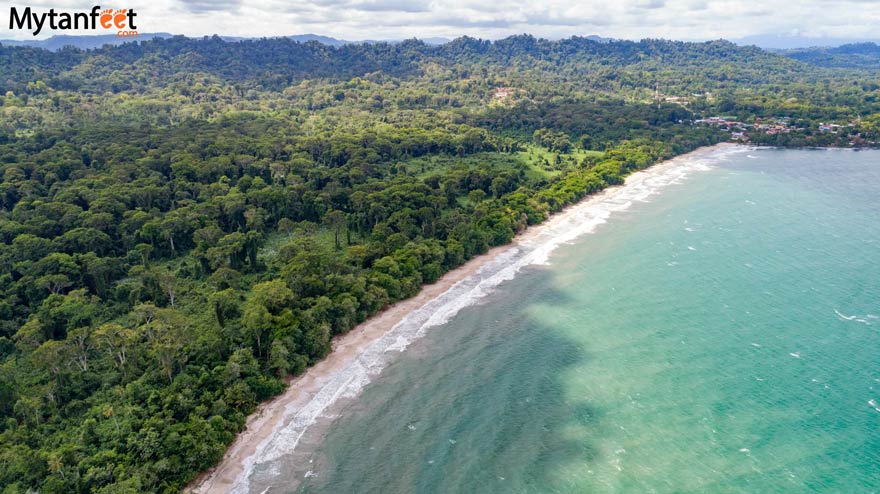
Unlike the Pacific, you won’t find any all-inclusive resorts, high rise condo towers or large international hotel chains in the Caribbean.
What you’ll find instead are just a few villas and bungalows hiding in a lush jungle that envelopes a picturesque beach with tall palm trees, bright turquoise waters and soft tan sand.
This is the charm of the Caribbean: pristine, non-commercial and untouched beaches.
Instead of concrete buildings, you’ll see huts with thatched roofs or bamboo bungalows as the community prefers to blend in with nature as much as possible.
You won’t be surrounded by a hundred tourists, you’ll be surrounded by more monkeys and sloths than people!
Pacific Side Beaches
The Pacific coast has a huge range of type of beaches. Furthermore, not all the beaches are developed and touristy. In fact, much of the Guanacaste coast is undeveloped since it is so vast.
There are just certain towns that are developed for tourism such as Tamarindo, Playas del Coco, Samara, Potrero, Flamingo and Nosara.
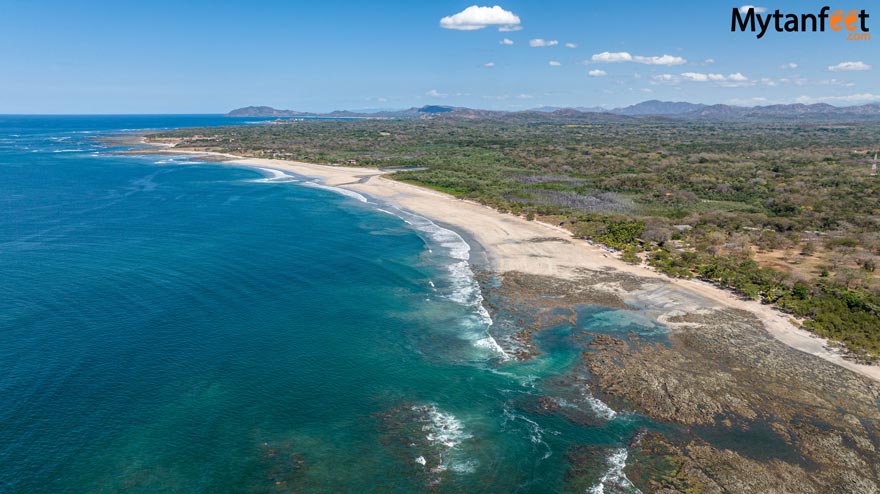
Jaco and Manuel Antonio are the most touristic and developed beach towns on the Pacific coast.
As Jaco is a city beach just 1.5 hours from San Jose, you will see plenty of high rise condos and beachfront hotels. Manuel Antonio has a ton of luxury hotels.
Down in the Costa Ballena, it changes completely as this area is still developing and very spread out. Nearly all the beaches in the South Pacific are dark sand and darker waters.
The South Pacific is a little like the Caribbean in the sense that there aren’t many people and it’s more jungley but it has dark sand beaches.
The Central and South Pacific beaches are beautiful but tend to have more rip tides than the North Pacific beaches. If you go in the water, you need to be extremely careful and pay attention to any warnings.
Most of the tourist ocean drownings occur in the Central and South Pacific. The North Pacific has more beaches with gentle soft waves, safer and more suitable for swimming.
Caribbean and Pacific Coast of Costa Rica Weather
If you are visiting Costa Rica in October, consider visiting the Caribbean side as the weather is better during that time of year than on the Pacific side.
Caribbean
The Caribbean coast of Costa Rica doesn’t follow the tropical tropical dry-rainy season weather pattern. Instead, the Caribbean is much more humid and can rain all year long. The summer month is October and the rainiest months are June and November on the Caribbean coast.
Average year round daytime temperatures on the Caribbean coast are low to mid 80s° F (26-30° C) and cools off at night. Humidity is extremely high all year round.
Pacific
The Pacific coast does follow the typical rainy and dry tropical season which is from the end of April to beginning of December and beginning of May to end of November respectively. The rainiest months are usually September and October and the hottest months are March and April.
The Guanacaste coast dry season turns the forests dry and very yellow, almost like a desert. Temperatures can soar into the high 90°s° F and low 100°s° F (38°° C) during March. In rainy season, it’ll be around 85°° F during the day (29°° C).
The South Pacific coast is a lot more humid which keeps the jungle green all year long like the Caribbean coast. It tends to rain harder and more down in the South so even if you’re visiting in February, it can rain. Temperatures are similar to the Caribbean side.
Things to do in Pacific vs Caribbean
Caribbean
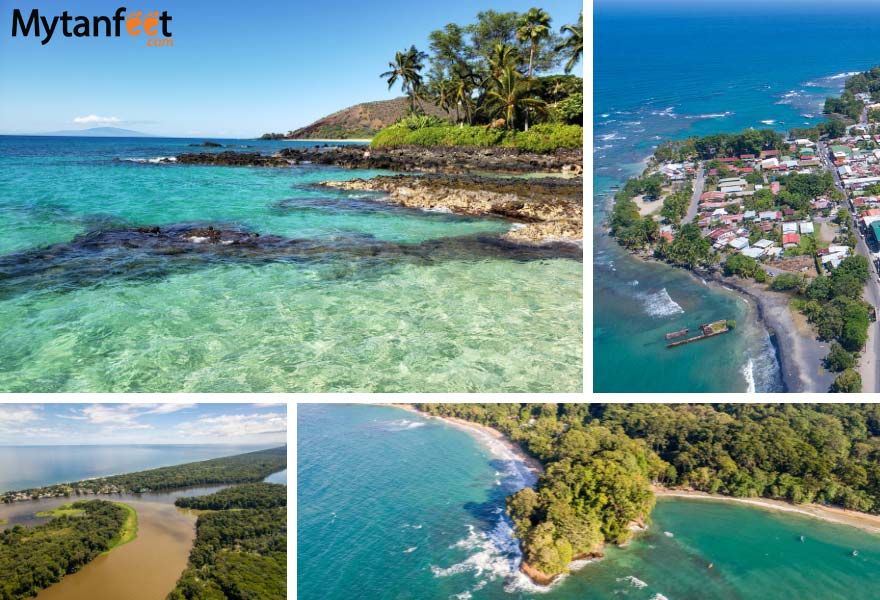
In Tortuguero, most people only stay 1-3 nights because it is a very small area. The main attractions are the national park and the turtles/wildlife. After those two things, there isn’t too much else. There’s one canopy zipline tour and you can hike or kayak in the national park.
In the Puerto Viejo area, there are more things to do. The best thing is that they’re all within a 30 kilometer radius!
From Puerto Viejo, you have Cahuita National Park, Gandoca-Manzanillo Wildlife Refuge, La Ceiba Private Nature Reserve, Jaguar Rescue Center, and a handful of beautiful beaches.
Not to mention you’re very close to Bocas del Toro so you can even hop over the border to Panama for a couple of nights!
Birdwatching is amazing in the Caribbean since you can see birds such as Keel-billed toucans, Great Green Macaws and unique hummingbirds. Since the Caribbean stays lush all year round, wildlife watching is incredible.
It’s common to see sloths snoozing in the trees or crossing roads, monkeys at the beach and snakes hiding in the bushes.
Surfing and snorkeling are two other popular activities in the South Caribbean but it is not as consistent as the Pacific and have fewer spots.
When it comes to snorkeling, Cahuita National Park has the longest coral reef so when the conditions are right, it is amazing.
The best adventure on the Caribbean side is white water rafting at Rio Pacuare which is one of the top 5 in the world!
Puerto Viejo is also a popular party town so you can dance till your feet give out to reggae music, slurp up tasty shots and enjoy bonfires at the beach.
Pacific
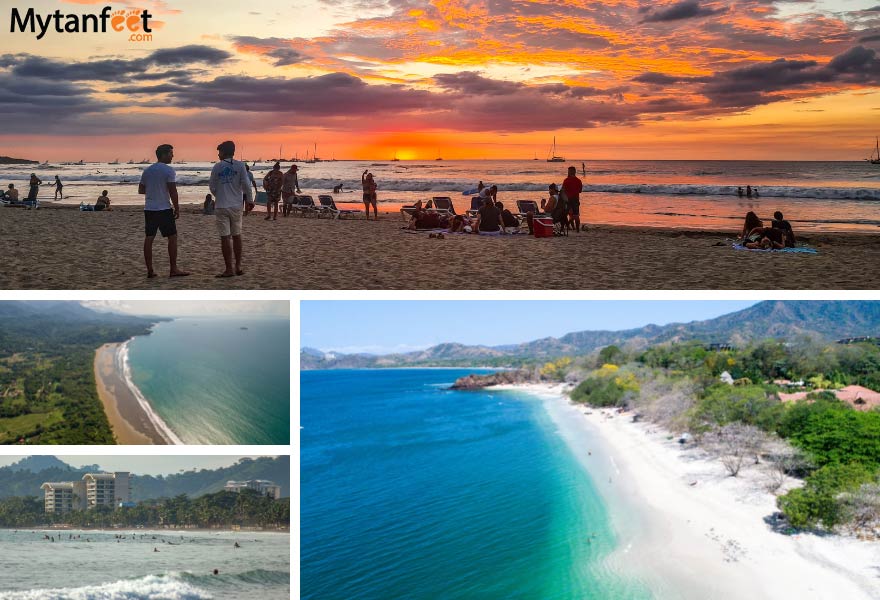
The Pacific side has many more national parks and better water sports like surfing, kitesurfing, fishing, scuba diving and snorkeling spots than the Caribbean.
When it comes to adventure and things to do, the Pacific does have more variety than the Caribbean. This is just because the Pacific is bigger with more tourist destinations.
Who should visit the Caribbean and Pacific
Caribbean
The Caribbean vibe is way more chill, relaxed and natural.
More Europeans prefer to visit the Caribbean since according to them, they don’t really want to go where the Americans go, which is the Pacific. Many Europeans aren’t keen on all-inclusive resorts or staying at fancy hotels either.
They rather experience nature and rural tourism, so they tend to gravitate towards the Caribbean. The months of August and September are extremely popular for Europeans on the Caribbean side, particularly Tortuguero.
The Caribbean side also attracts more birdwatchers, young USA/Canadian nomads and hippies since they like the unspoiled atmosphere.
Pacific
When it comes to vibes and crowds, the province of Guanacaste is much more touristic and developed with more American/Canadian expats and immigrants. You will find a lot of all-inclusives in this area.
The Nicoya Peninsula including Nosara and Samara maintain low key vibes, but are equally touristic.
The Central Pacific towns of Jaco and Manuel Antonio are extremely touristy and developed. The South Pacific is very low key and less touristic since this area is much more spread out.
Canadians and Americans love the Tamarindo and Playas del Coco area. We actually wrote a post comparing Tamarindo and Playas del Coco in case you’re trying to decide.
Many young American and British adults like the Guanacaste area because it has more all-inclusive resorts and is more developed.
Surfers, yogis and those interested in more rural areas like the Nicoya Peninsula and Costa Ballena (Uvita, Dominical, Ojochal) for the laid back atmosphere and undeveloped nature.
Reasons to Visit the Pacific Side of Costa Rica
You can have a great time on either side of Costa Rica but here are some reasons why you should visit one over the other.
Two of the main reasons why you should visit the Pacific side of Costa Rica over the Caribbean are that there are more choices and a closer proximity to the international airport and attractions.
There are more beach towns, more hotels, more activities, more national parks, more snorkeling spots and more surfing spots on the Pacific than the Caribbean.
This is just because the Pacific is more developed and bigger. You can spend two whole weeks in Guanacaste and just get a taste for what the North Pacific has to offer.
Another reason is close proximity to the airport. The closest beach town to Guanacaste Airport, Playas del Coco, is only 25 minutes away!
Additionally, Guanacaste has more sunny days. Lastly, it has more resorts so the tourist infrastructure is more developed in Guanacaste and the Central Pacific.
Reasons to Visit the Caribbean Side of Costa Rica
There are a plethora of reasons to visit the Caribbean side of Costa Rica. First and foremost, you will experience a unique side of Costa Rican culture as it has heavy Caribbean influence.
Furthermore, the wildlife is incredible. And in such a small radius too. If you want to see sloths, monkeys, turtles, snakes, frogs, macaws and toucans, you can tick all of those off your list in just one national park on the Caribbean side (Tortuguero).
Check out this Costa Rica in 8 days itinerary that goes to Tortuguero, BIjagua and La Fortuna for wildlife and nature.
Another reason is the natural charm. You can experience a Costa Rica only found in that corner of the country! The beach and jungle landscapes and scenery are absolutely breathtaking and it’s green all year long, unlike the North Pacific.
It’s also not as hot as the Pacific. Since the climate is different and can be cloudy most of the time, it’s hot but a very comfortable hot whereas the Pacific can get unbearably hot. But the trade off is that it is very humid all year long on the Caribbean coast and may rain any time of the year.
And another reason is the food. Caribbean Costa Rican food is so delicious and I have never been able to find a better rice and beans than at our favorite restaurant, Soda Lidias in Puerto Viejo.
How to Visit Both Coasts
Below are our sample itineraries that visit both the Caribbean and Pacific coast of Costa Rica.
13 days Costa Rica itinerary: Puerto Viejo, La Fortuna & Monteverde
2 week Costa Rica itinerary: Caribbean and Pacific
10 day Costa Rica itinerary: San Jose, Puerto Viejo and Manuel Antonio
Wrap Up
To make it easier, here is a quick wrap up. To visit both coasts, you need time. So for short vacations 1 week or less, it is not advisable to visit both coasts.
If you are flying in and out of Guanacaste Airport, visit the Guanacaste coast or Nicoya Peninsula. For short trips, it’s best to stay on the North or South Guanacaste side.
If you are flying in and out of San Jose International Airport, want to visit several destinations and have more than 1 week-10 days, you can definitely visit both the Caribbean and Pacific side.
However, if you have less than 5 full days in Costa Rica, we recommend only one side, either Caribbean or Pacific but not both.
If you are visiting Costa Rica in October, visit the Caribbean side as it’s the “summer” month there.
Costa Rica Vacation Checklist
- First time to Costa Rica? Read our First Time in Costa Rica guide.
- Not sure how to move around Costa Rica? Read our How to Get Around Costa Rica guide to find the best transportation method for you.
- Click the link to get our detailed Costa Rica Packing List so you know what essential items to bring.
- Check our Costa Rica destinations map and Costa Rica restaurant map
- Do not forget to purchase Travel Insurance for your trip to Costa Rica.
- Stay connected by purchasing a prepaid SIM Card in Costa Rica
- Save money with Mytanfeet Deals for tours and hotels and our Costa Rica Car Rental Discount.
Amanda says
Hi Sammi!
Thanks for the all the details in this article. Now I really want to visit both coasts!
We are going to be in Costa Rica for 14 days, flying in and out of SJO, end of june until July 11th. I would like to pick 3 home bases:
– La Fortuna (4 nights)
– Monteverde OR La Bijagua —- not sure which, but thinking 3 nights
– Samara area… or Cahuita? — last 5 nights
Do you have any suggestions based on the timing of our trip? I want to make sure we are seeing a little bit of everything 🙂
Thank you so much!
Sammi says
Hi Amanda, I’d go with Samara as it’s closer to Monteverde/Bijagua and has chances of better weather. We sent you an email with more details.