
If you’re planning on visiting the enchanting Rio Celeste, Costa Rica then here is everything you need to know about the sky blue river inside Tenorio Volcano National Park.
In this guide, we will help you plan the perfect visit to Rio Celeste.
This post has affiliate links which we may earn a small commission from if you choose to purchase, at no extra cost to you. Listed prices are quoted in USD and are estimates. More info: Disclosure
IMPORTANT: Since mid 2025, the trail down to the Rio Celeste waterfall observation point is closed. You can only go down the stairs a little bit. You can still see the waterfall, but you can’t go all the way down. Check the official Tenorio Volcano National Park Facebook page for updates.
Purchasing Park Tickets
Tenorio Volcano National Park entrance fee for adults is $12 USD and $5 USD for children (ages 2-12) plus tax.
Park tickets must be purchased online beforehand on the SINAC website (official government run national park website). They do not sell tickets at the door.
Visitors must present the bar code of their park ticket reservation (can be a screenshot on your phone) and their passport (for foreign tourists) or Costa Rican ID to enter.
Passport can be a photocopy or photo on the phone of the passport ID page.
If you did not purchase park tickets beforehand, there is an area with Wifi next to the ticket office so you can buy tickets.
However, it is not a guarantee there will be availability, as it’s first come, first serve.
This means you may not get park tickets at the time you are there. All the entrances are divided into 40 minutes increment groups.
You will have to purchase the next available time slot, so you may have to wait if the time slot when you are there, is full.
Tenorio Volcano National Park
The national park is open every day from 8 AM to 4 PM.
First entry at 8 AM, last entry at 1:45 PM. Everyone must exit by 4 PM.
- Single use plastics are not allowed in the national park so bring an insulated reusable water bottle.
- No facilities inside the national park. Only bathroom is at the park entrance.
- No paper maps available.
- No pets allowed in the national park. No strollers allowed.
- ~6 kilometer walk total (~3.7 miles)
Do You Need a Guide for Rio Celeste?
No, a guide is not required or necessary for Rio Celeste, you can perfectly visit Rio Celeste on your own. It’s a straightforward linear trail with plenty of signage.
However, if you would like a guide, there are usually naturalist guides for hire at the entrance.
There may be 2 or 3 hanging out by the national park entrance, offering their services. They charge around $55 USD for a group and $10 USD per person for larger groups.
Their guiding services are usually for 3 hours. You can negotiate with them prices and times.
Ask them for their carnet or Costa Rican guide certification with an ICT number to prove they are official guides, and not illegal guides.
Why is the River Blue?
The story as told by the locals is that Rio Celeste got its stunning color when God dipped his brush in the river as he was painting the sky.
Scientifically, the color appears when two separate clear water rivers meet and a certain type of mineral coated in silicon, oxygen and aluminum remains suspended in the river.
The size, suspension and reflection of sunlight creates this vivid blue color in the water.
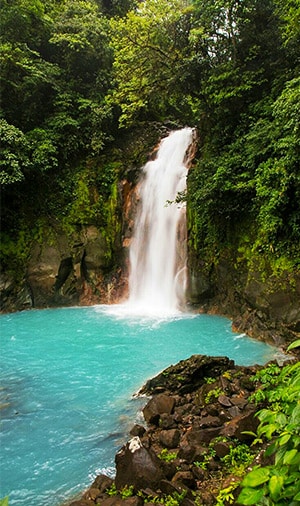
The national park land used to belong to the Maleku people, an indigenous group in Costa Rica. The waterfall and river were sacred places to them.
This park is very busy
Tenorio Volcano National Park is one of the five most visited parks in Costa Rica.
Since they limit the number of visitors per day, expect crowds if you are visiting during December through April, as that is the busiest time of year. July is also another busy month.
Another reason why this national park feels crowded is because it’s only one linear trail. The trail is not a loop so everyone has to walk back on the same trail they came in.
Weather
Rio Celeste weather is hot and humid being the tropical rainforest. Average daytime temperatures are around low to mid 80s° F (26°-28° C). It is very humid.
Tropical dry season is typically December through April and rainy season is typically May through November.
This area doesn’t strictly follow the dry-rainy tropical seasons and it can rain any time of the year, even in the dry season.
What to Wear to Rio Celeste
- Shoes: No flip flops, no high heels, no open toed sandals. You need to have good sturdy closed toed shoes. Yeison wore his waterproof KEEN hiking shoes. I wore my water repellent On Women Cloudtrax hiking boots.
- Clothing: Shorts or lightweight hiking pants and tee shirt or tank top. Whatever you wear, wear clothes that dry fast and wick away moisture due to the humidity.
- Mosquito repellent: We got bit bad during our last visit. I like to use the wipes.
- Gear: Bring waterproof rain gear, especially if you’re bringing camera equipment. We brought a heavy duty poncho, our North Face rain jackets, Aqua Quest waterproof backpacks and a backpack rain cover.
- Hat or visor.
- I like to bring a small microfiber towel to wipe away the sweat.
Optional: hiking poles for those who need help with steps. We saw many seniors using hiking poles or a big walking stick as the trail has lots of rocks, steps and some mud.
Rio Celeste, Costa Rica hiking difficulty and time
The Rio Celeste trail in Tenorio Volcano National Park is roughly 7 kilometers or 4.34 miles total, it can take you around 3 hours.
The trail to the Rio Celeste waterfall is around 1.8 km or 1.1 miles one way, so around 4 km total (2.5 miles). 1.5 km is on a trail to the waterfall entrance, then it is 253 steep steps down to the waterfall.
The Rio Celeste trail is not terribly long or difficult but for inexperienced hikers, some sections may prove a little challenging.
The waterfall steps and the section going to the Laguna Azul with more steps and big rocks are the trickiest parts.
The trail isn’t handicap friendly nor is it stroller friendly.
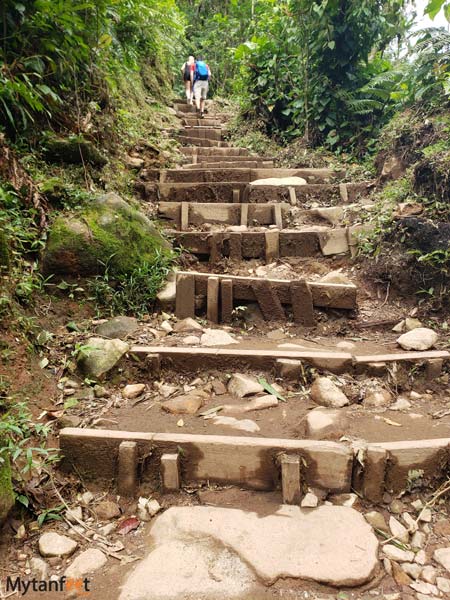
If you are not in good condition to walk the whole trail, or you have bad knees or ankles, I recommend going to just the Rio Celeste waterfall.
The trail to the waterfall takes around 30 minutes and is on a mix of concrete and dirt, crossing one short suspension bridge and a couple of small creeks.
To the waterfall, the stairs have handrails so you can stop and rest.
The river may not be blue if there is a tropical storm
The river may not blue when it has been storming a lot, usually during October, November, December and January and sometimes February.
However, if it is just the normal on/off rains, do not worry as it turns back to blue quickly. We have seen the blue color every time we have visited Rio Celeste, even during rainy season.
If you’re visiting during the rainier months, we recommend staying a couple nights in Bijagua. You’ll have more opportunities to see the blue river just in case it rains during your visit.
Sometimes, if there has been a terrible tropical storm, the national park may close as the trails may get too muddy.
Check the official Tenorio Volcano National Park Facebook page to see current conditions before your visit.
Swimming is prohibited in the park
Swimming in Rio Celeste is strictly prohibited inside the national park.
However, there is a free public entrance by the bridge 1 kilometer (~.6 mile) past the park entrance. You can walk down to the river and swim in it.
It’s one of the best free things to do in Costa Rica.
On Google Maps, it is called “Rio Celeste Danta Free Pool.” There is a dedicated parking spot on the side of the road for this free Rio Celeste swimming hole. Parking 1000 CRC.
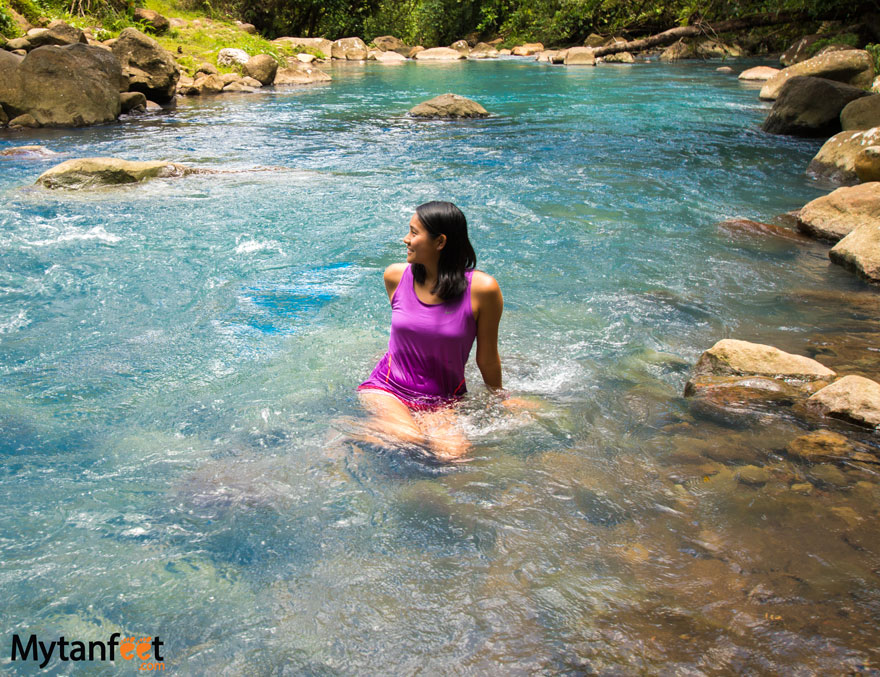
There are also some other private properties that also have access to the Rio Celeste river that allow their guests to swim and bathe in it.
We went to Cabinas Piuri for lunch and a visit to their own private access to the river.
Visiting Rio Celeste with kids
You can definitely visit Rio Celeste with kids, especially if they have a lot of energy or are outdoorsy.
If you bring your baby, infant or toddler, I highly recommend a baby carrier so that you can have your hands free, in case the trails are muddy.
Make sure you have enough stamina to carry them up and down the steps to the waterfall and the rest of the trail.
Strollers are not allowed inside Tenorio Volcano National Park.
How to Get to Rio Celeste in Tenorio Volcano National Park
The closest town near Rio Celeste is Bijagua de Upala. Rio Celeste is inside Tenorio Volcano National Park in the Alajuela and Guanacaste province.
Rio Celeste is 95 kilometers (59 miles) from Guanacaste Airport, a 1.5 hour drive and 173 kilometers (107 miles) from San Jose International Airport, a 3.5 hour drive.
GPS
If you are renting a car and using Google Maps or Waze, do not type in “Rio Celeste.” This will take you to a wrong place or say no results found.
Enter Parque Nacional Volcan Tenorio, Parque Los Pilones or Parqueo del Parque Nacional Tenorio as your destination. This will take you to the parking lots right outside the Tenorio Volcano National Park.
There is no cell phone signal up near the park with Kolbi so make sure you download Google Maps offline.
Tenorio Volcano National Park Parking
You will know when you’ve reached the park entrance because you will see a lot of signs for parking.
There will be locals wearing yellow vests waving flags, trying to get you to park in their lot.
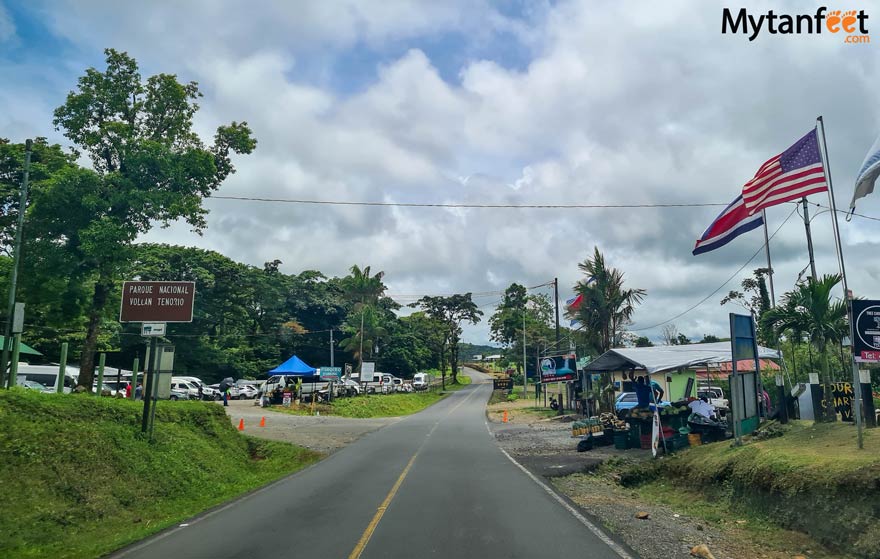
We prefer to park at the parking lot right at the entrance (left side in the photo above). Parking costs 3000 CRC per car and you need to leave the slip of paper in the dash of the car. Pay in Costa Rican colones, local currency.
Even though you’re paying for parking, don’t leave valuables visible in the car. This parking lot is not owned by the national park.
These parking lots are manned by locals who charge for parking, but they will not take any responsibility if something happens to your car or belongings.
There is a “free” parking lot across the street near the mini market, but we recommend to park in the paid ones, just in case.
How to Get to Rio Celeste from La Fortuna
The drive from La Fortuna to Rio Celeste is about 1.5 hours.
Planning tip: If you are driving from La Fortuna – Guanacaste (like Tamarindo/Playas del Coco), you can stop by Rio Celeste on your way.
We recommend to leave La Fortuna around 7 AM to get to the park around 9 AM, hike around 3 hours, have lunch and depart Bijagua by 2 PM to drive 2-3 hours to your final destination in the daylight.
Leaving Luggage in the Car
If you have to leave luggage in the car, we recommend to park in the paid parking lots as close to the office as possible. We have seen a lot of tourists leave their luggage in the car. Put it all in the trunk if you can.
If you have an SUV, get a luggage cover from your rental car agency. Take your valuables (passport, phone, credit cards, wallet, ipads, etc.) with you.
*These are our tips but we are not responsible if something happens to your car or belongings as everyone needs to take extreme caution when leaving things in the car in Costa Rica.*
High Clearance Car Highly Recommended
We recommend a 4×4 in the rainy season and in the dry season, a high clearance SUV.
The road to the entrance of Tenorio Volcano National Park (Rio Celeste) is paved. However, from Bijagua, it is a very curvy and narrow road without street lights or raised pavement markers.
Some sections are concrete and can get very slippery when wet. There are also a couple of very small narrow bridges.
Also, the speed limit is not really respected or well displayed here. If someone tailgates you, don’t try to pull over as there are no shoulders. Just go the speed you’re comfortable with.
Get our Costa Rica car rental discount and extra freebies like 2 free drivers, free luggage cover, free prepaid SIM card and more!
Shuttle or Bus
There are no public buses or a local shuttle that go directly to the Tenorio Volcano National Park entrance.
I have never seen Uber in this area. A taxi to the entrance from Bijagua costs around $40 USD, prices may not reflect the current day. You can also ask your hotel to help you call a ride.
Rio Celeste, Costa Rica Map
Here is a map of Tenorio Volcano National Park. They no longer provide paper maps. You can take a photo of this exact same laminated map at the office entrance.
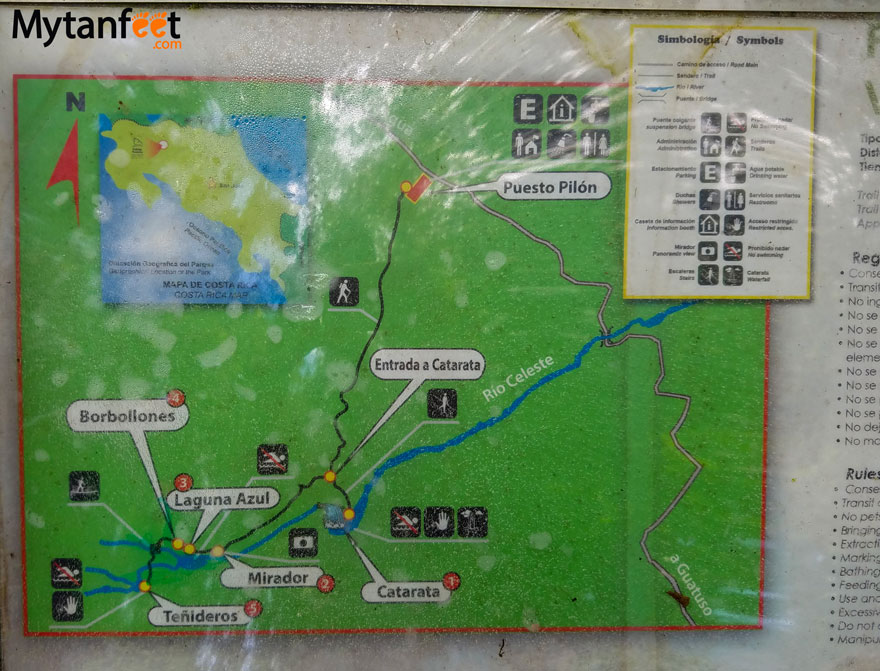
The orange square where it says Puesto Pilon is the entrance to the national park and start of the trail. Entrada a Catarata is where the steps are down to the waterfall.
Catarata is the waterfall. Laguna Azul is the blue lagoon, Mirador is the view point.
Borbollones is the area where the water is hot and bubbly (like a hot spring) and Tenideros is where the the two rivers join together to create the one sky blue river.
Entering the National Park and Facilities
Before you can enter this area, you will go through the security check and ticket check. The park officer asked me for my park ticket which I showed on my phone.
They need to see the barcode and email receipt.
Then he asked me if I had any cigarettes or knives and quickly checked my backpack. They checked for a drone as drones are not allowed in the national park.
After we passed the first checkpoint, we used the bathrooms and entered the national park to start the hike.
Waterfall Trail (1.5 kilometers or .9 miles to waterfall steps from entrance)
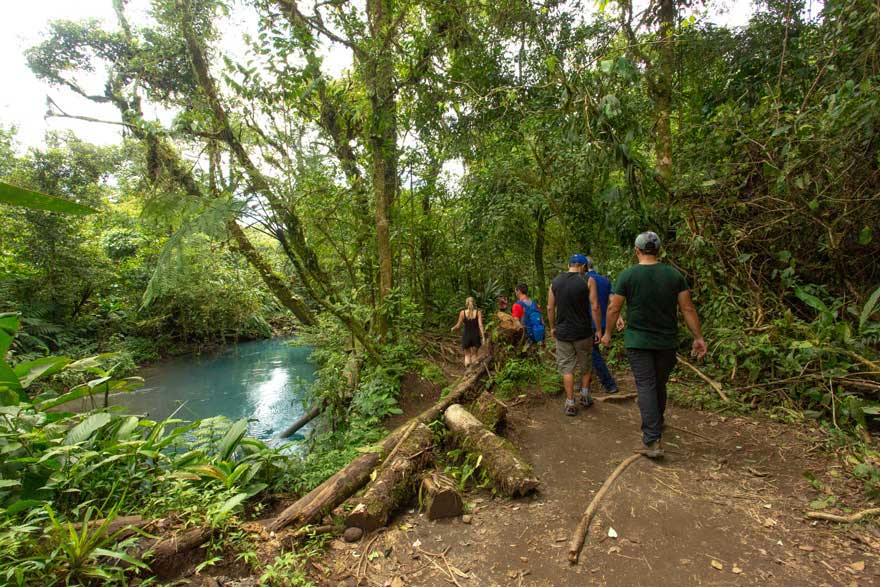
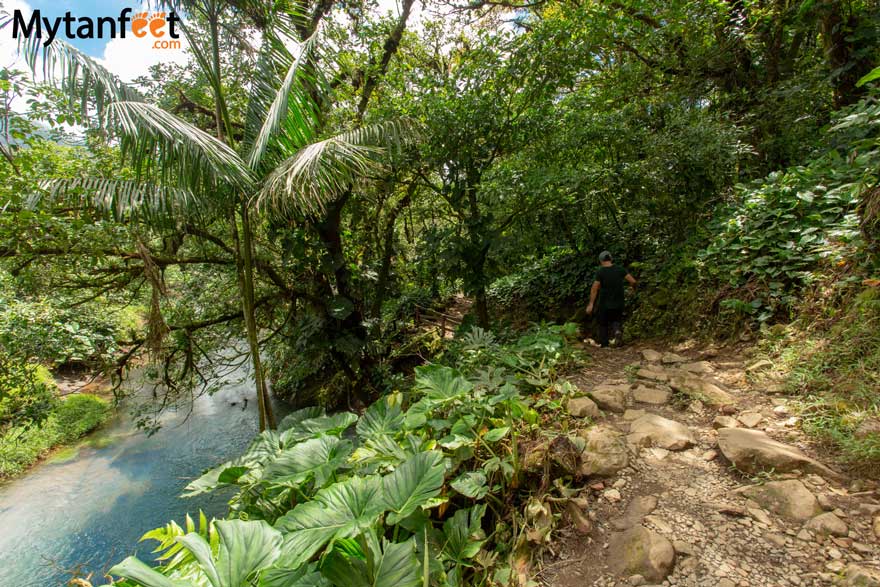
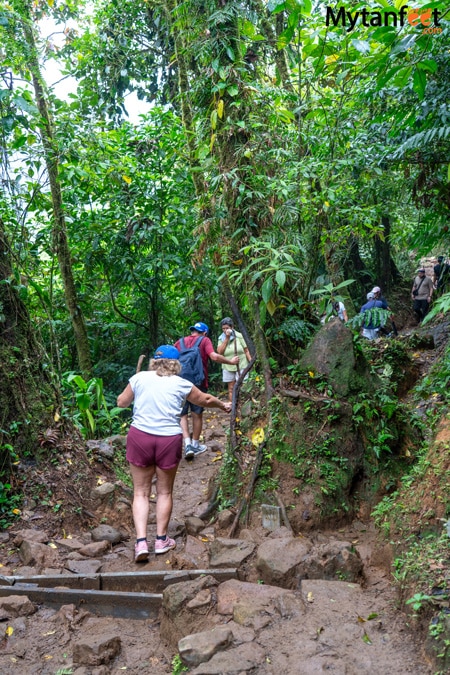
The beginning of the trail is mostly concrete surrounded by a verdant primary and secondary rain forest.
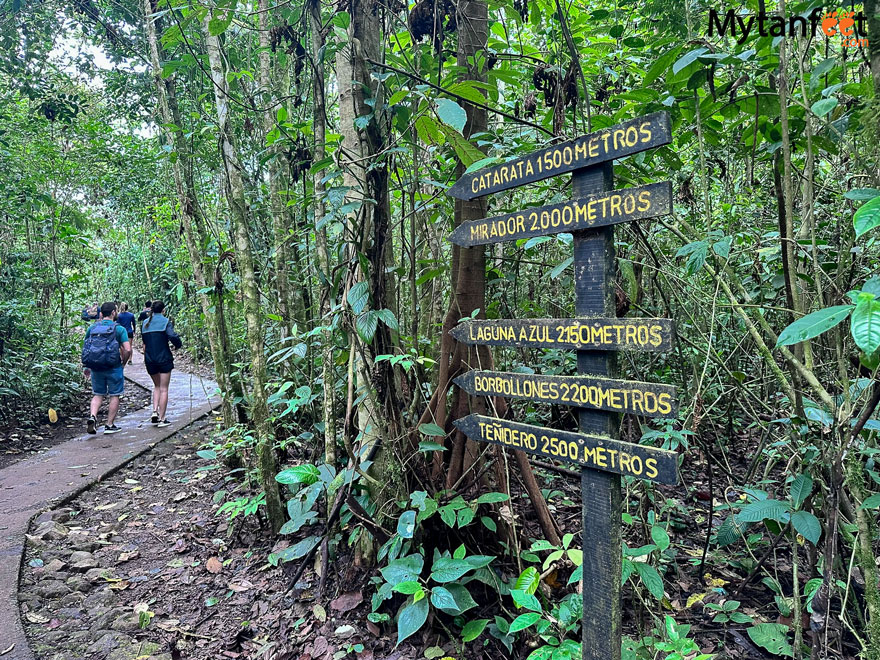
The first part of the trail is to the waterfall, about a 30 minute walk.
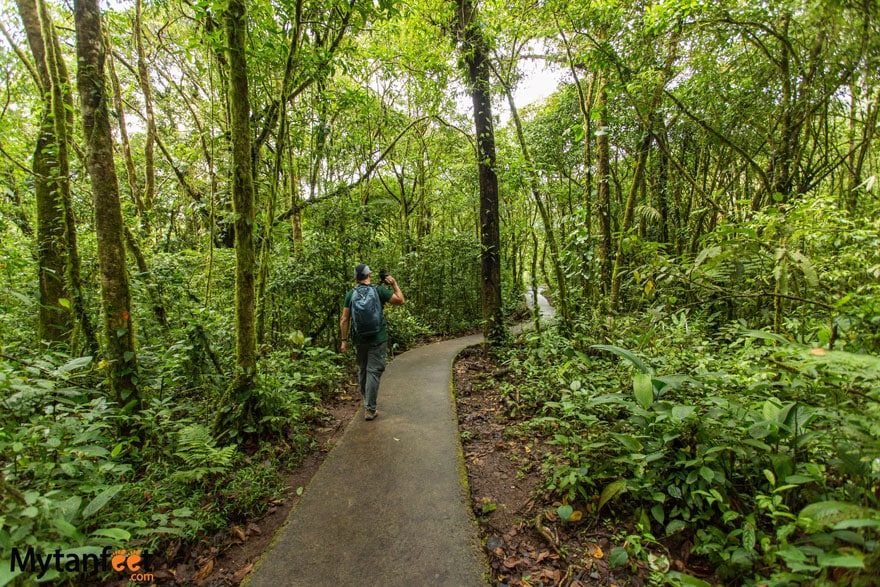
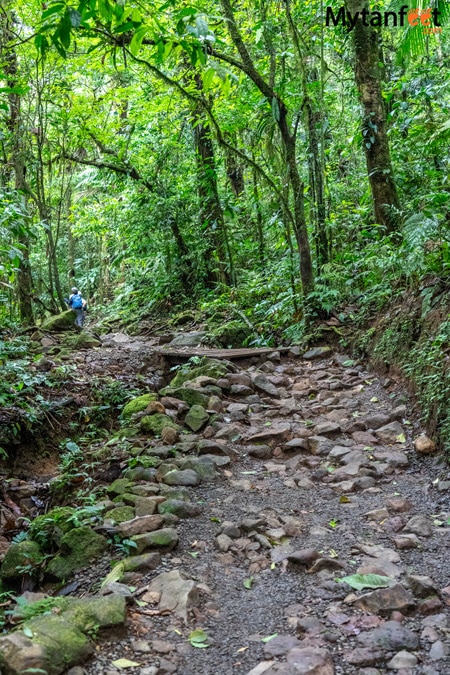
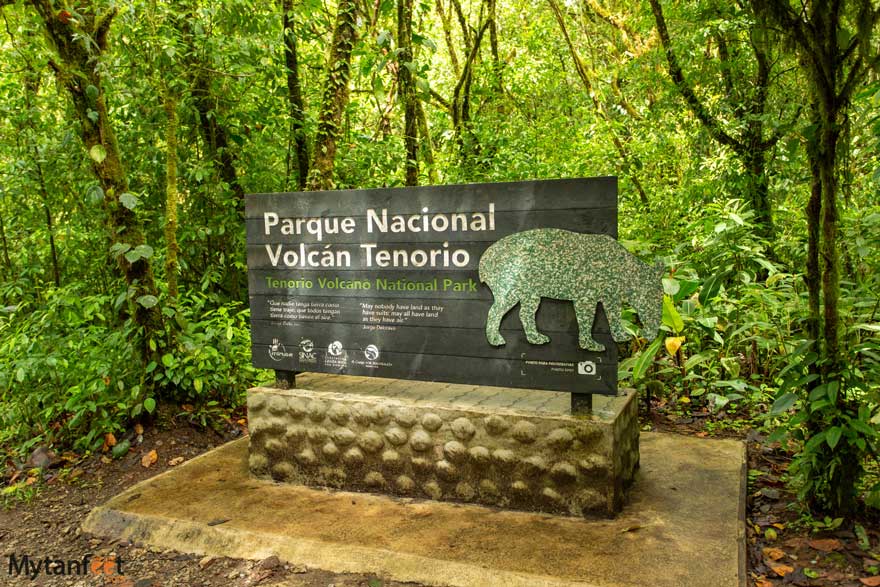
There is a very nice Tenorio Volcano National Park sign that makes for a nice photo.
There are a couple of water faucets here in case you need to wash off your shoes or wash your hands.
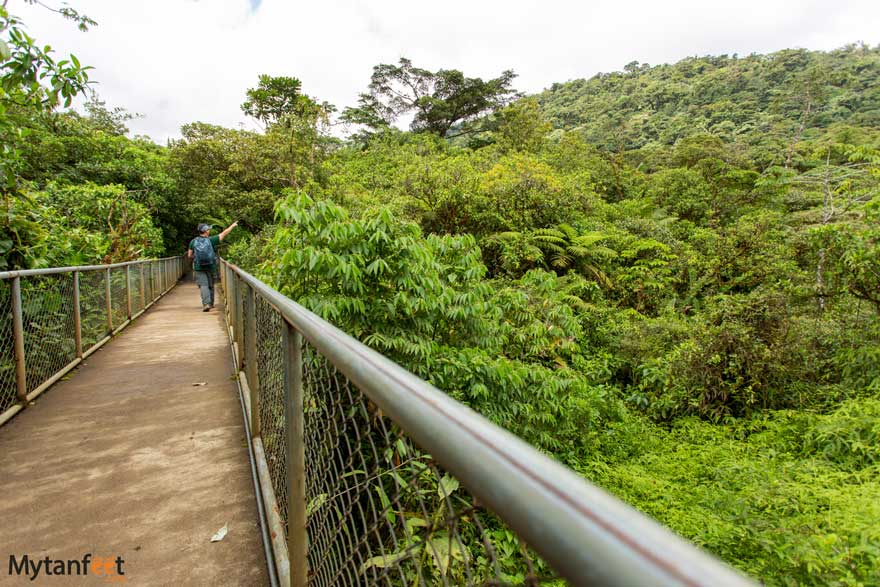
A little after, you’ll cross a suspension bridge. We saw white face monkeys right by here!
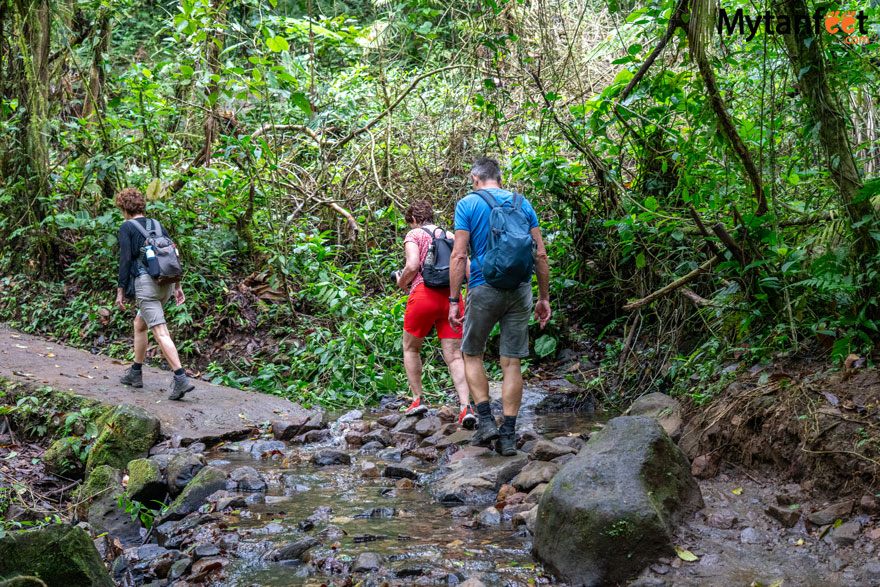
After walking through two very small creeks and the rest of the trail, you’ll come to an area with a couple large signs and the stairway arch to the waterfall.
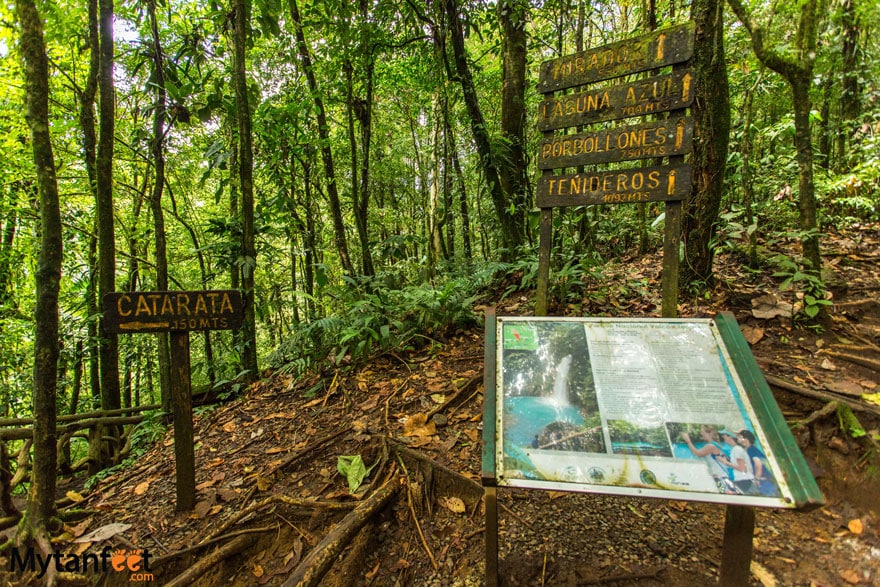
You’ll reach a cross section to go to the waterfall or continue onto the trail.
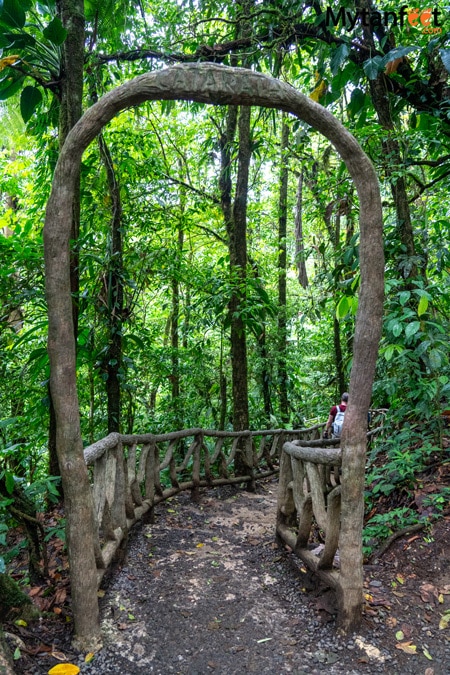
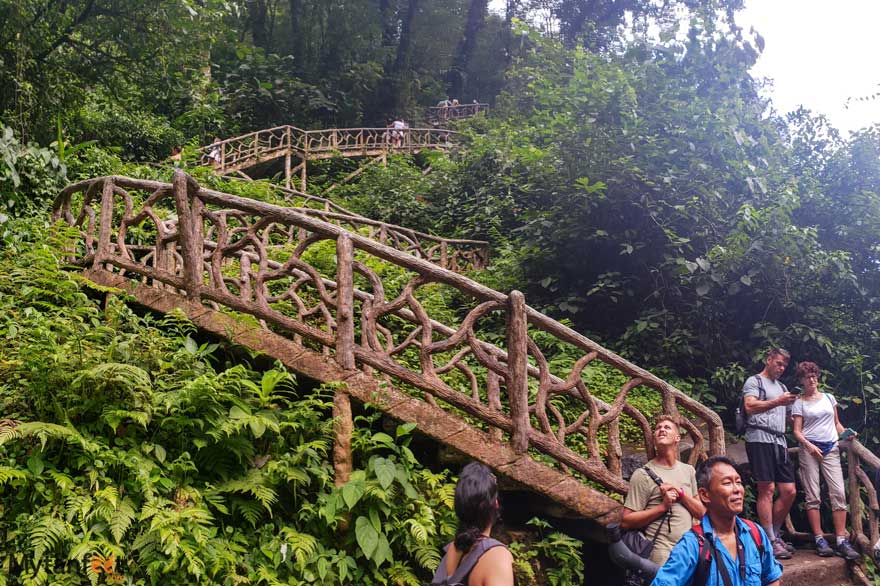
As you walk down, you get glimpses of bright blue through the trees. It is 150 meters or 490 feet down to the waterfall – there are 253 steps!
There are some great spots on the stairs to take very nice photos of the stairs and waterfall.
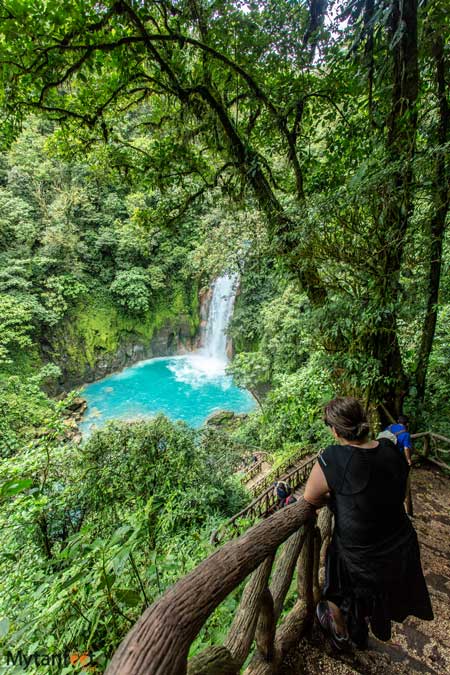
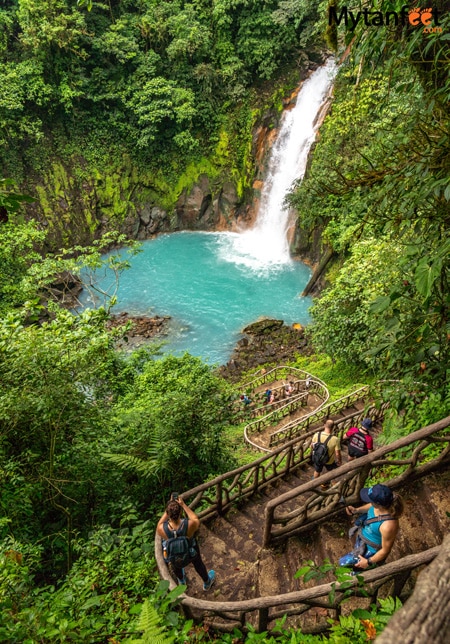
Once you reach the bottom, there is a nice viewing platform for photos.
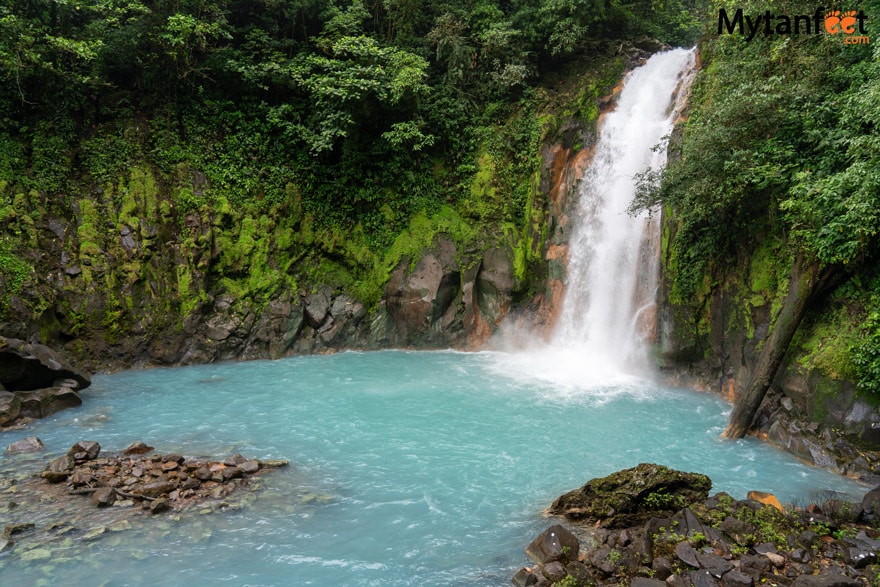
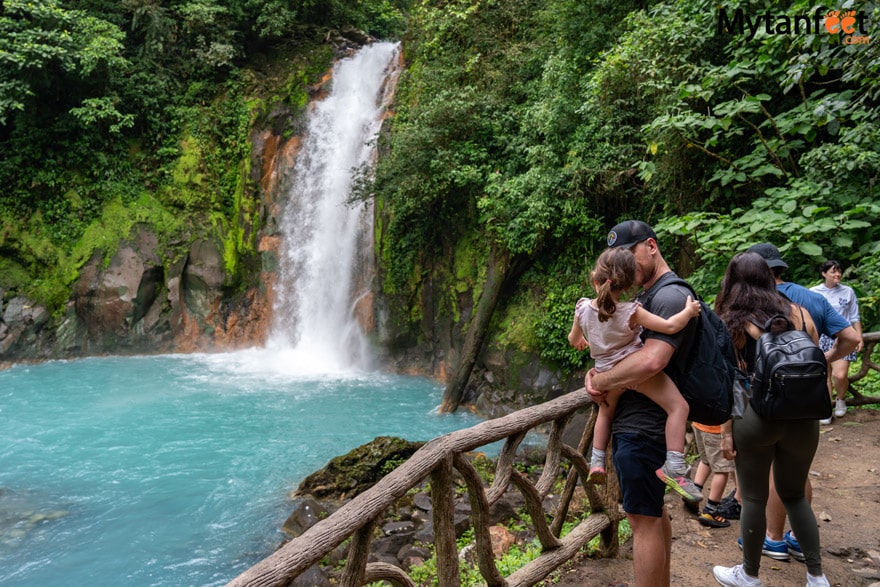
The waterfall greets you at the bottom and it is an incredible sight. I could’ve spent all day at this enthralling waterfall. You can’t help but stare at the bright blue water!
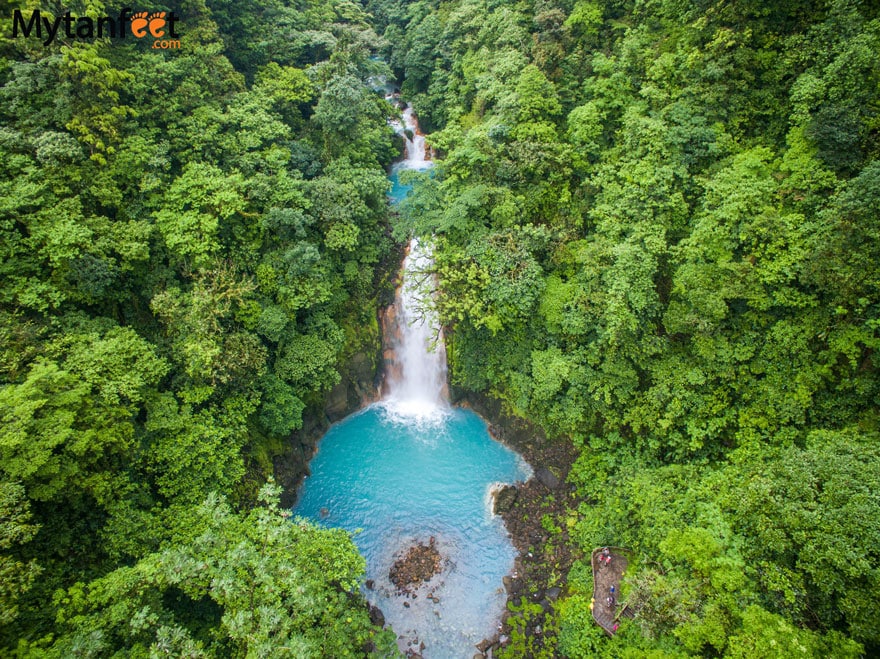
Here is an aerial photo of Rio Celeste waterfall. We took this back in 2016 when drones were allowed. Drones are NOT allowed in the national park anymore.
After you’re done looking at the waterfall, head back up to continue on the rest of the trail.
Mirador (550 meters, .3 miles)
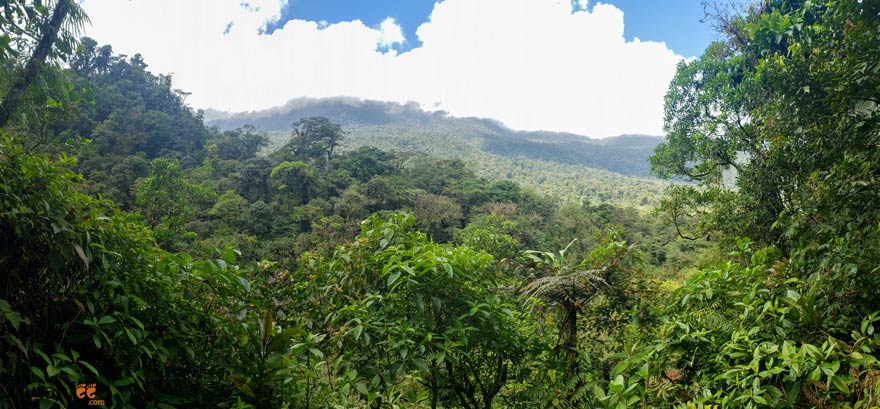
This spot has a nice view of the jungle. There’s nothing else at this view point.
Laguna Azul (Blue Lagoon, 200 meters, .1 miles)
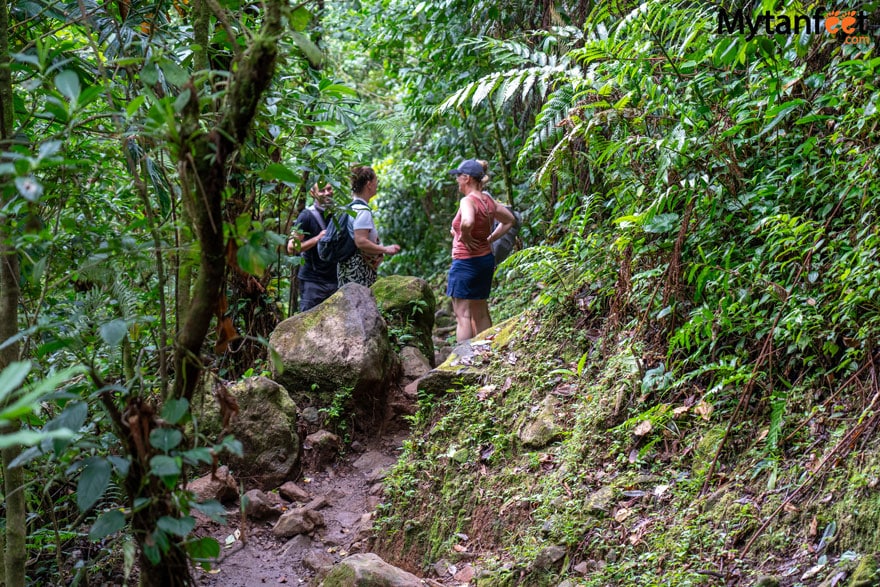
The Laguna Azul, or blue lagoon is the next stop. There are some steeper steps and large rocks going down to the blue lagoon.
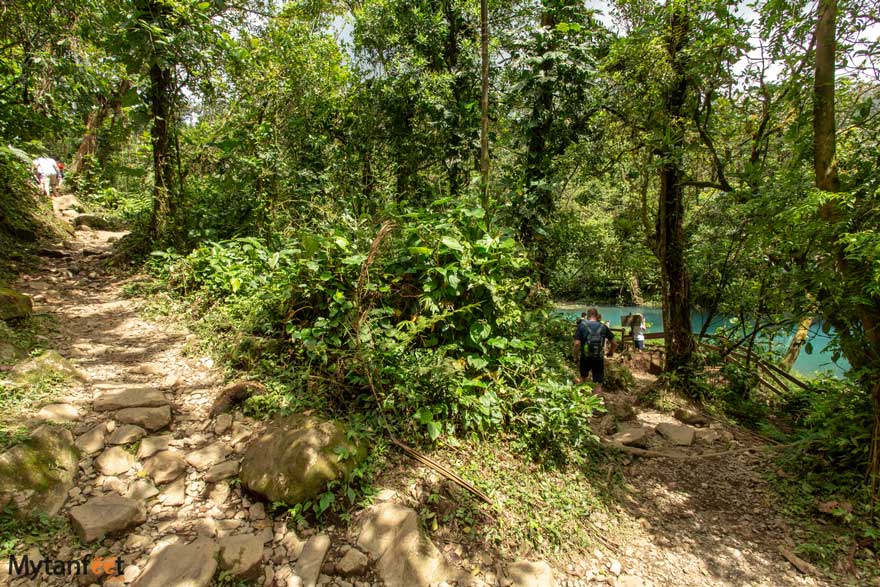
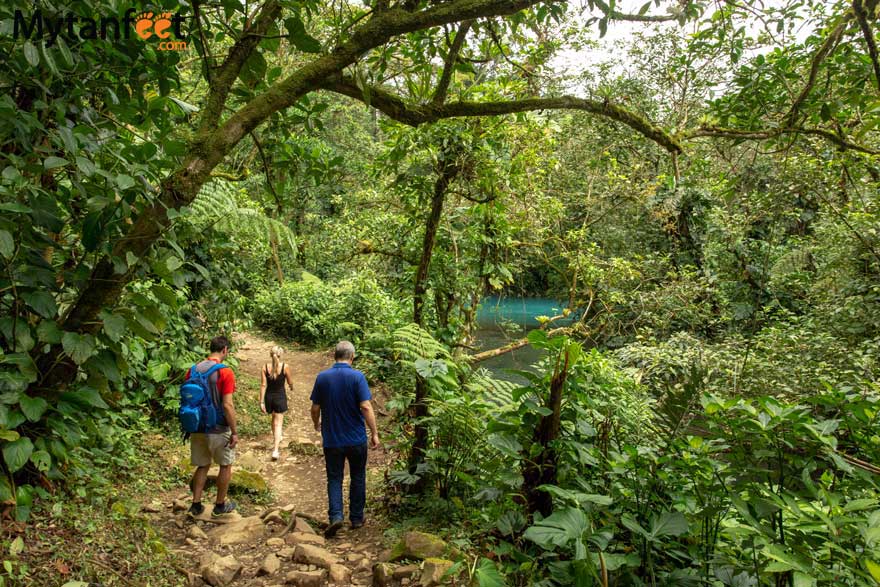
You can really see how blue it truly gets at this point!
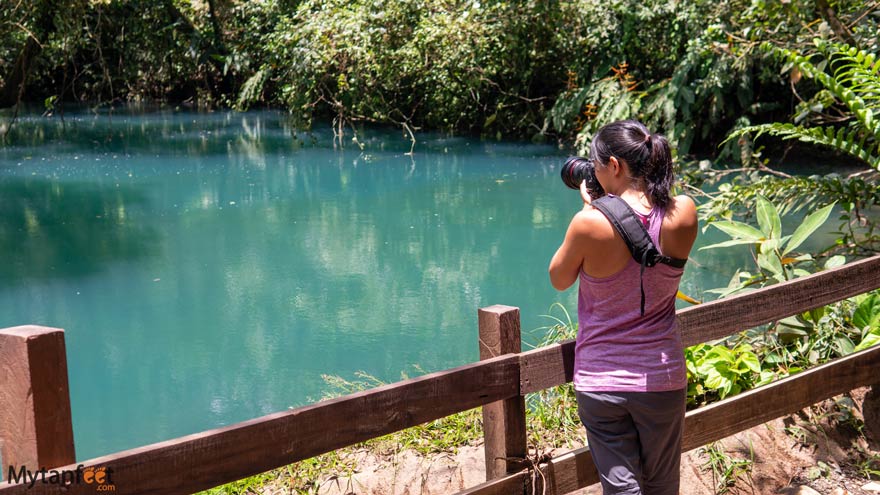
50 meters past the laguna azul are the bubbling thermal springs.
Borbollones (50 meters, 164 feet past blue lagoon)
Here you can see the boiling water section of the river.
You can really smell the sulfur at this point so you can imagine just how hot that water is!
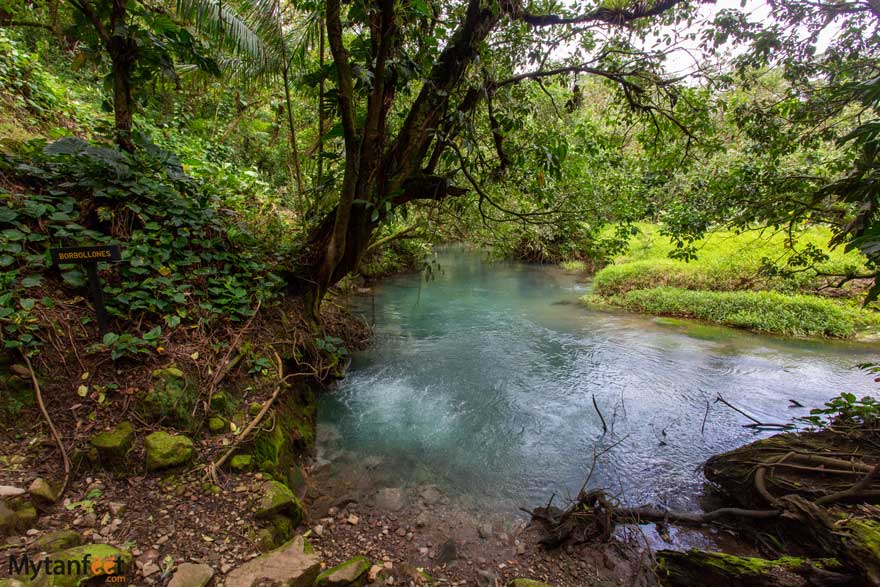
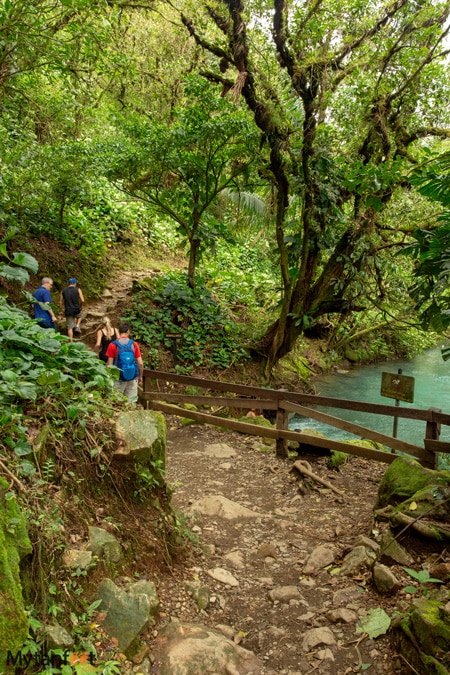
The last 300 meters or so of the trail are not to be missed. You’ll see where the two clear water rivers meet to create the sky blue river.
You may see animals on the trails like pizotes, armadillos and monkeys.
Teñideros (last 300-400 meters, about 900-1000 feet)
There are two bridges to cross before you reach Tenideroes. The first goes over the normal river (no blue color).
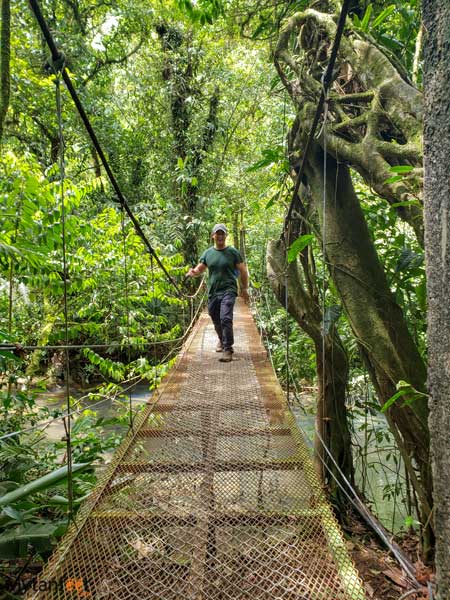
The second bridge goes over the blue river and it is absolutely gorgeous.
On the other side, there is a small area past the trees to the right where you can get some photos of people on the bridge.
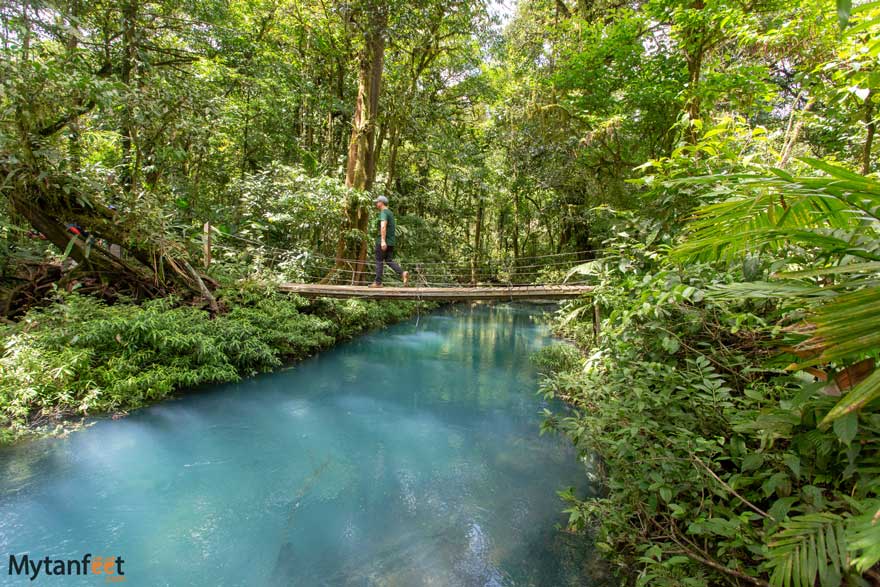
Cross the bridge and walk a tiny bit further to see where two different rivers meet to create one blue river.
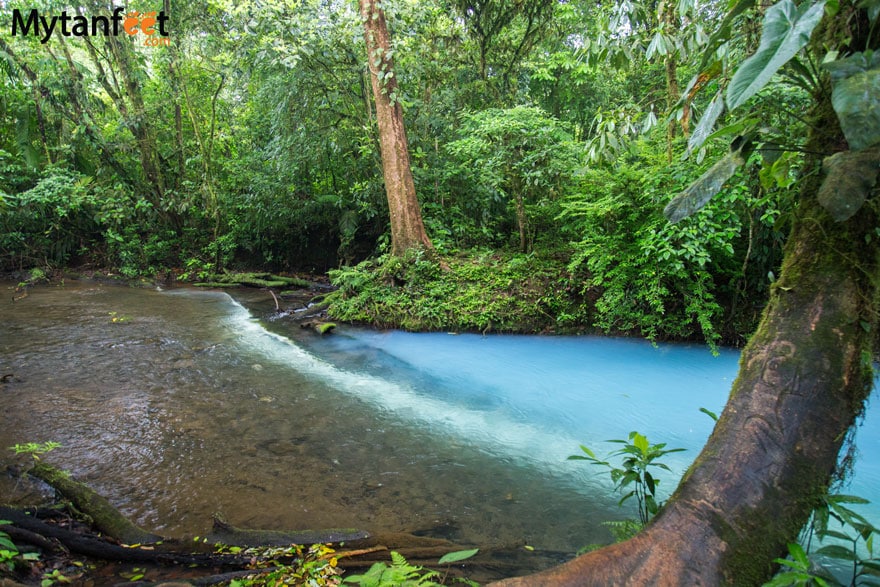
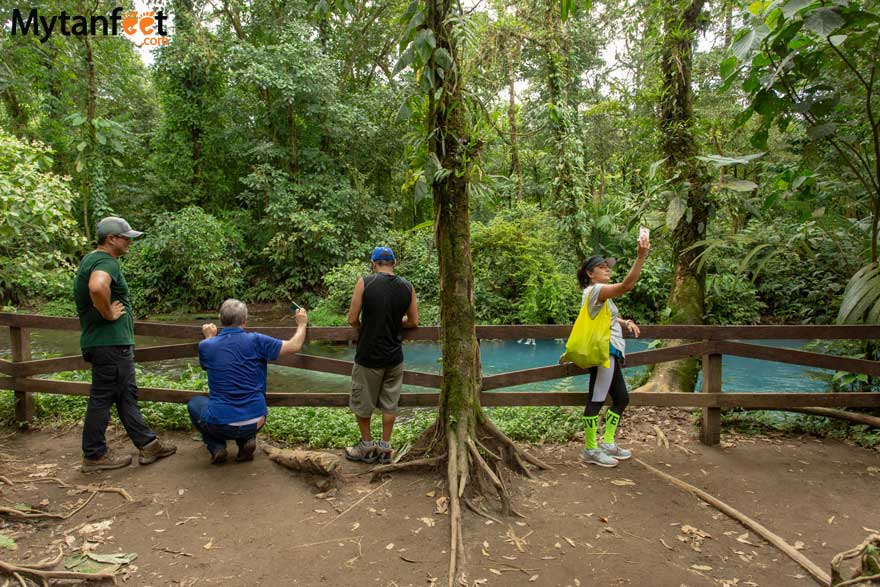
This is the coolest part of the hike, seeing where the color starts. There is a billboard in Spanish and English that explains exactly where the blue color comes from.
And that’s the end of the trail.
Head back the same way you came and enjoy the rest of the hike.
Outside the park entrance are a couple of local restaurants.
We also highly recommend getting some yummy fruit or cold coconut water (pipa fria) at the fruit stand across the street.
They had a good selection of fruit and he also cracked open my coconut for me so I could eat the yummy meat inside.
Rio Celeste Tours
You can visit Tenorio Volcano National Park – Rio Celeste as a day trip from La Fortuna or Guanacaste.
The day trips include roundtrip transportation, bilingual guide, lunch, national park fee and refreshments.
Interested in this tour? Contact us and we’ll be happy to assist from both La Fortuna and Guanacaste.
Rio Celeste Hotels
A beautiful, luxury hotel right by the park entrance is the Rio Celeste Hideaway Hotel. This hotel has their own private entrance to a section of the Rio Celeste river.
Read about other waterfalls hikes in Costa Rica!
Catarata del Toro: Amazing 270 foot waterfall in an extinct volcano crater in Bajos del Toro
Catarata Llanos de Cortes: Beautiful waterfall near Liberia, Guanacaste
Blue Falls of Costa Rica: Two small, sky blue colored waterfalls (similar to Rio Celeste) in Bajos del Toro
Costa Rica Vacation Checklist
- First time to Costa Rica? Read our First Time in Costa Rica guide.
- Not sure how to move around Costa Rica? Read our How to Get Around Costa Rica guide to find the best transportation method for you.
- Click the link to get our detailed Costa Rica Packing List so you know what essential items to bring.
- Check our Costa Rica destinations map and Costa Rica restaurant map
- Do not forget to purchase Travel Insurance for your trip to Costa Rica.
- Stay connected by purchasing a prepaid SIM Card in Costa Rica.
- Save money with Mytanfeet Deals for tours and hotels and our Costa Rica Car Rental Discount.
Diane Cybart says
Does the fee to park have to be paid in CRC or do they also take US Dollars?
Sammi says
You can pay in USD (credit card only, no cash)
Chanell says
Headed back to CR for the 2nd time this May. We are traveling from Liberia to Arenal first. Do you think stopping at Rio Celeste on way to Arenal is within reason and how safe is parking lot? We would have luggage in car. Thanks!
Sammi says
It is possible but the latest entry into the park is at 2 PM so just keep that in mind and May is rainy season, so there is a chance it may be rainy.
Sammi says
This really depends on how well she can walk, because the waterfall is about 30 minutes from the entrance on a very nice straight path BUT to see the actual waterfall, you have to walk down a lot of steep stairs which I don’t know if she can do. She could skip the waterfall and continue onto the trail to see the blue lagoon and rest of the river but that part of the trail turns more “wilderness” (the first part actually has a concrete path), from the waterfall and on, it’s dirt, rocks, tree roots, some steps, etc. so I honestly don’t know how much of the park she will be able to walk and see.
I would recommend to take her to the public access instead so she can see the blue river and swim in it, it’s right off the side of the road. LIkewise, you could check out places like Cabinas Piururi which has their own short walking access to the blue river and they have a picnic table and offer food/drinks
Diana says
Hi guys, I love your Blog. I’ve been reading all your recommendations. Regarding Rio Celeste, we would like to bring my mom (90). I know that the trails are not handicapped accessible. My mom can walk but obviously not for long distances. Is there any part of the park that we can take her to that would be an easy walk for her? Look forward to hearing from you. Diana
Bonnie says
So my family and I (me, my husband, and 4 kids) have a trip planned in late March/early April and we will be staying a few days in La Fortuna and then traveling by rental car to Coco Beach to stay a few more days. I am hoping to be able to stop at Rio Celeste en route, after checking out of our La Fortuna hotel and before arriving in Coco. My question is if it would be safe to leave all our luggage in the trunk of our rental SUV while we hike Rio Celeste, or would it get stolen? We would have all our stuff with us. Also, if we arrive by early afternoon, do we still have a good chance to be able to enter the park, if we arrive before 2pm? Or are all the slots filled usually by that time? Thanks.
Sammi says
Hi Bonnie, I would try to get there as early as you can because end of March/early April is spring break for N.America and it is also Semana Santa here, Tenorio Volcano NP is one of the top 5 national parks in the country and so it is incredibly busy during that time of year so I’d get there like as early as it opens, they can only allow a maximum number of people in the park per day and once that number is reached, they won’t allow any more people in even if it’s well before 2 PM.
Chelsea says
Hello!
We are a family of 4 trying to travel to Costa Rica in January. I am looking at a flight that arrives in Liberia at 11:00 am. Would it be possible to drive to Rio Celeste Hideaway hotel before dark?
We are landing in Liberia and our first stop is Arenal. Does it add a lot of extra time to the drive to go Liberia-Rio Celeste-Arenal versus Liberia-Arenal? My thought was that we would land at Liberia at 11am, drive to a hotel near Rio Celeste and stay the night, visit the waterfall early the next morning, and then drive to Arenal after. Does this sound reasonable?
Sammi says
It gets dark at 6 PM everyday in Costa Rica and the drive between Rio Celeste and La Fortuna (Arenal) is about 2 hours so it is doable.
Derek says
Hello! I’m visiting La Fortuna in January and am planning a visit to Rio Celeste. Do you think we would be able to pair a 6am bird watching hike at Mistico with the trip to Rio Celeste? We will have our own rental.
Sammi says
Depending on how long your birding tour is (maybe a couple of hours?) it’s about a 2 hour drive from La Fortuna to Rio Celeste (maybe a bit more because Mistico is a little further) and you have to enter the Tenorio Volcano National Park before 2 PM.
John says
Hello! We’d like to hike and see the waterfall at Rio Celeste but it looks to be over 2.5 hours to drive there from Tamarindo. Are there any other similar hikes/waterfalls closer to Tamarindo?
Sammi says
unfortunately no, it’ll all require at least around 2 hours driving from Tamarindo, there is another one called La Leona waterfall hike that is a blue river (but it’s really not that similar to Rio Celeste because this one is in a dry forest and the waterfall is different) but it’s about 2 hours from Tamarindo
Johanna says
Hi! Great site. Thank you. Do you know if I can take my dog into the park on either a leash or in a backpack. He is 11 lbs.
Sammi says
Dogs are not allowed in national parks
Tash says
Hi, thanks so much for the great blog post! I was just wondering if there is any way of getting to tenorio via public transport or any way without having a rental car?
Thanks so much!
Sammi says
Unfortunately there isn’t a public bus that goes directly to the national park entrance
Denese Gordon says
We will only be in Rio Celeste area for 2 days 3 nights. What are the not to be missed activities nearby? I was thinking Hiking Rio Celeste & Tenorio National Park, and Sloth and Hanging Bridges. Could I do the tubing with one of the 2 activities above, I am not sure how long the hikes are.
Thank you
Sammi says
Hello, you can check our Bijagua, Costa Rica guide for more ideas.
Sandy OReilly says
Hi We currently have 2 nights booked at Finca Amistad Cacao Lodge for hiking to Rio Celeste, the chocolate making tour and whatever other activities in the area. Then we have 2 nights at Borinque Resort and Spa. Are these two areas much the same and, if so, should we chose between them and stay in one place or maybe stay 3 nights in Bijagua and 1 at Borinque? We were interested in the hot springs/mud bath experience – but the Bijagua area looks like there are lots of different experiences. Your suggestions? We are in CR for 5 weeks so will be covering a lot of ground – all on the Pacific Side.
Sammi says
They’re both super nice and are different since BIjagua doesn’t have hot springs or mud baths