
If you are visiting Costa Rica with food allergies, you need to do proper research before you arrive.
Costa Rica does not have FDA enforced cross contamination protocols, or mandatory staff training for food borne allergies, but touristic places are becoming more aware and attentive of food allergies.
With correct preparation on your part, it is definitely possible to visit Costa Rica with food allergies without any problems.
Ultimately, do not visit Costa Rica with food allergies without travel health insurance. Purchase Travel Insurance options for your trip in the link.
This post has affiliate links which we may earn a small commission from if you choose to purchase, at no extra cost to you. Listed prices are quoted in USD and are estimates. More info: Disclosure
Costa Rican Food
The staple ingredients of Costa Rican food are rice, beans, and corn. Squash and plantains are also common.
For meat, they eat mostly beef, pork and chicken.
For vegetables, they eat mostly lettuce, cabbage, tomatoes, onions, and cilantro.
For seafood, it is mostly fish and shrimp.
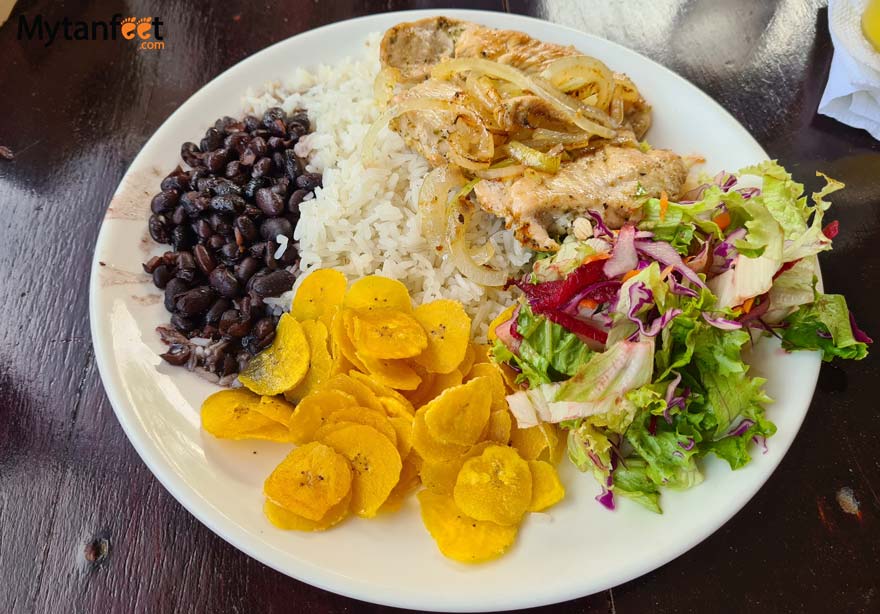
Learn more about Costa Rican food in the link!
Nuts and Peanut Allergies
Luckily, peanuts and sesame are not a common ingredient in Costa Rican food and local restaurants – sodas, do not commonly use peanut oil for cooking.
Asian restaurants cook with peanuts and sesame more often and may use peanut oil. It will be best to avoid any restaurante chino or Asian restaurant in Costa Rica to avoid cross contamination.
Western/Americanized restaurants will also have more peanuts on their menu than Costa Rican restaurants.
Peanut in Costa Rican Spanish is maní (emphasis on the ni).
Sesame ajonjolí
Other countries say cacahuates for peanuts, but in Costa Rica, peanuts are known as maní.
Some people are only allergic to tree nuts but those are not common in Costa Rican cooking.
Nut: nuez
Almond: almendra
Macadamia: macadamia
Cashew: marañon
Pistachio: pistacho
Hazelnut: avellana
Brazil nut: nuez de Brasil
Pecan: pacana/nuez pecana
Walnuts: nuez or nuez mariposa or nuez de castilla.
In Costa Rica, walnuts are just nueces.
I am allergic to peanuts: Soy alergico(a) al mani
I am allergic to nuts: Soy alergico(a) a los frutos secos (this is better if you are allergic to a lot of different nuts like peanuts, almonds, cashews, all tree nuts)
What to Avoid Eating in Costa Rica That May Have Peanuts/Nuts
- Horchata, a blended sweet drink can contain blended peanuts in Costa Rica.
- Cajeta, a popular Costa Rican candy, a milk based fudge that may have peanuts inside.
- Pistachio is a popular ice cream flavor with nuts inside.
Peanuts can be found in ice cream shops as it is a common topping for desserts. They are mostly eaten as a packaged salted snack, so if a tour operator says “snacks are included” make sure to ask what kind of snack.
Shrimp/Shellfish Allergies
Jason has an extremely severe shrimp allergy. He is also allergic to crab and shellfish, but not fish. Costa Rica eats a lot of seafood and you can find specific restaurants just for seafood, called marisquerias.
English to Spanish words below for common seafood.
- Shrimp: camaron
- Shellfish: mariscos
- Fish: pescado
- Crab: cangrejo
- Octupus: pulpo
- Squid: calamar
- Clam: almeja
I am allergic to shrimp: Soy alergico(a) a los camarones.
I am allergic to seafood: Soy alergico(a) a los mariscos.
We normally will say something like, Soy MUY MUY MUY alergico a los camarones because Jason is VERY allergic to shrimp. If he ingests one, he will go into anaphylactic shock so we have to be SUPER careful.
Even if he puts something cooked in the same oil that was used to cook shrimp in his mouth without chewing it, he will get a reaction. Not life threatening, but his mouth will get red and swollen with bumps and gets very itchy.
What to Avoid in Costa Rica with Shrimp and Seafood
- Arroz con camarones – rice with shrimp. This dish is super common and you’ll find it at pretty much every single local restaurant.
- Arroz con mariscos – rice with seafood (clam, shrimp, mussels, squid, fish, octopus). Also very common at local restaurants and seafood restaurants.
- Sopa de mariscos – seafood soup (clam, shrimp, mussels, squid, fish, octopus). Mostly at seafood restaurants.
- Ceviche. Costa Rican ceviche is usually made with fish, but some places have a shrimp ceviche or seafood ceviche.
Dairy Allergy/Lactose Intolerant
I am lactose intolerant and although sometimes I just deal with it because I love some of the Costa Rican desserts so much, other times, it is easy to avoid.
Milk is widely used in most Costa Rican desserts and only in very few dishes. Plant based alternatives are kind of common, depending on where in Costa Rica you are.
If you’re in the capital city/Central Valley (San Jose/Alajuela/Heredia/Cartago) or the touristy towns like Jaco, Manuel Antonio and Tamarindo, you can readily find plant based alternatives at the supermarket and at cafes.
Milk: leche in Spanish
Butter: mantequilla in Spanish
Cheese: queso in Spanish
Yogurt: yogurt in Spanish
Cream: crema in Spanish
Lactose: lacteos in Spanish
Oil: aceite in Spanish
Common Costa Rican Food with Dairy
Arroz con leche – rice and milk pudding.
Pollo en salsa blanca – chicken in white sauce (has heavy cream and butter)
Copos/churchills – Costa Rican shaved ice with condensed milk, milk powder, ice cream (sometimes), syrup
Tres leche: 3 milk cake
Natilla: sour cream, usually a breakfast accompaniment
Something to take note is that sometimes, the meat or veggies are cooked with butter or margarine. Sometimes, even the gallo pinto (rice and beans breakfast dish) is cooked with butter. Always ask!
Was this cooked with butter? – ¿Esto se cocinó con mantequilla?
Esto tiene lacteos: Does this have lactose?
The Caribbean coast uses a lot of coconut milk in their dishes and it’s absolutely delicious. I LOVE going to the Caribbean to eat since I can have pretty much everything.
Egg Allergy
Eggs in Costa Rica are generally only eaten at breakfast. Easy to avoid when ordering at a restaurant.
Egg in Spanish is huevo.
Not many Costa Rican dishes uses eggs, besides baked desserts.
One traditional Costa Rican dish you *may* see is barbudos but this is not common, not even in sodas. These are cooked green beans mixed with scrambled eggs.
Another is chorreada, which is a corn pancake, normally sweet and made with eggs, eaten for breakfast. These are more common in the Guanacaste province, but not often seen on the menus.
Gluten Free/Celiac Disease
It is not difficult to eat gluten free in Costa Rica as the main staples are rice, beans, and corn.
If you order tortillas, check that they are made of corn and not flour.
English to Spanish translations below.
Flour: harina
Corn: maíz
Gluten: gluten
Wheat: trigo
Without wheat/gluten: sin trigo/sin gluten
One important thing is that some sauces or seasonings may contain gluten, so for the safest option when eating out, ask for food without sauces or seasonings.
Vegan/Vegetarian
If you are vegan or vegetarian, read our tips on visiting Costa Rica as a vegan or vegetarian for the full breakdown.
Basically, you can easily eat vegetarian food in Costa Rica. Gallo pinto with eggs and cheese, vegetarian casados, rice with veggies, patacones with pico de gallo, guacamole and refried beans and black bean soup are some of my favorite vegetarian Costa Rican dishes.
For vegans, you need to be more vigilant on asking if any food is cooked in butter, instead of oil and if anything had chicken bouillon seasoning (consome de pollo).
Before You Leave for Your Trip
If you or anyone in your group are visiting Costa Rica with food allergies, here are the things you need to do before you leave, especially if the allergy is severe.
Write Your Allergy on a Piece of Paper in Spanish and English
You MUST do this. Write your allergy on a piece of paper in both Spanish and English. I recommend to type it out and print it, for the best clarity and no confusion.
You can also print a picture of your allergy with a giant red X on it, with the word “IMPORTANTE” (important) and show it to the waiter just in case.
Bring Multiple EpiPens
Epipens are not available in Costa Rica. Please make sure to bring your own. We recommend to bring at least 3-4 per person. Remember to check the expiration date.
If you run out of Epipens, you cannot buy them at the pharmacy or go to a hospital to get a prescription, because they aren’t available.
How it works in Costa Rica is you can get a prescription for epinephrine, which you can buy at a pharmacy, usually a hospital pharmacy. The epinephrine comes in vials, so you will also need to purchase syringes to manually load the epinephrine when needed.
This is how locals, Jason included, manages. He carries epinephrine and Chlorphenamine maleate (first generation antihistamine) vials and multiple syringes with him in a hard pencil box and brings it every time we go out.
Take Note of Nearby Hospitals/Clinics to Your Destinations
Lastly, research nearby hospitals and private clinics close to your destinations. If you have a reaction, you may require intravenous treatment afterwards.
911 works the same in Costa Rica as the emergency help line.
If you are in more rural areas, there may not be any nearby hospitals. Your only choice may be private clinics, which may not be 24 hours or be open on weekends.
Look up emergency clinics in the destinations you’ll be going to, especially if you have young kids.
During Your Time in Costa Rica
When you are in the country, here are our tips to visiting Costa Rica with food allergies to stay safe.
Never Assume Restaurants Will Always Take Responsibility
If you have a food allergy, it is your responsibility to take care of your health. If that means packing your own food or cooking at home, it is always better to be safe than sorry.
In touristic destinations like La Fortuna, Tamarindo, Manuel Antonio and Santa Teresa where there are more expats and immigrants, most Western/tourist restaurants and tour operators are actually very good at understanding food allergies.
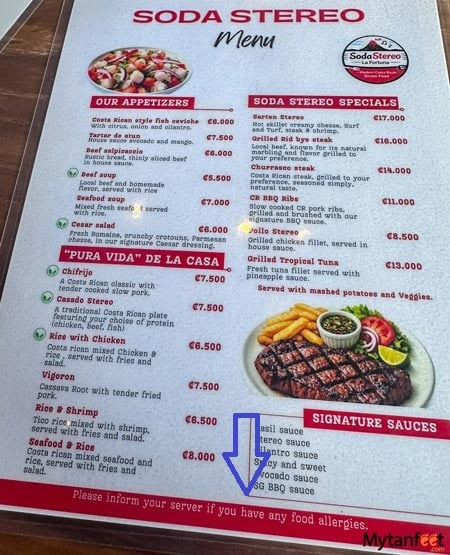
However, if you have a very severe food allergy, we recommend avoiding the local restaurants (called sodas) in the more rural areas, especially if you do not speak Spanish fluently.
Sometimes, the staff will not take it too seriously or be that careful, so cross contamination can easily occur as everything may be cooked in close proximity or cooked with shared oils.
Remember to purchase Travel health Insurance to be covered for any incidents/accidents!
Carry Your Meds With You ALL the Time
To emphasize the earlier point, cross contamination is always a risk when you have severe life threatening food allergies.
ALWAYS carry your EpiPen and meds with you – even if you are not going out to eat. You never know if someone else will need it and you can save someone’s life (this has happened to us before!)
Carry Your Piece of Paper with Your Allergies With You Too
Also bring your piece of paper that lists your allergies with you whenever you go out. This is especially important if you are allergic to any medicines, in case you get into an accident.
Cook Your Own Food
Many tourists with food allergies will rent an Airbnb or VRBO with a fully equipped kitchen, so they can buy groceries and cook at the rental.
Labels are very clear at the supermarkets and some even have their own gluten free aisle. This makes it easy to buy snacks and food to cook.
Read more about grocery shopping in Costa Rica in the link.
If you’re visiting Costa Rica with food allergies on a long term stay, check out Market y More. It’s an online grocery delivery service that has items from all throughout Costa Rica with clearly marked labels. Delivered right to your door!
Costa Rica Vacation Checklist
- First time to Costa Rica? Read our First Time in Costa Rica guide.
- Not sure how to move around Costa Rica? Read our How to Get Around Costa Rica guide to find the best transportation method for you.
- Click the link to get our detailed Costa Rica Packing List so you know what essential items to bring.
- Do not forget to purchase Travel Insurance for your trip to Costa Rica.
- Stay connected by purchasing a prepaid SIM Card in Costa Rica. Get 10% off your Airalo eSIM package with our promo code “mytanfeet”
- Save money with Mytanfeet Deals for tours and hotels. Save more money with our Costa Rica Car Rental Discount.
Leave a Reply